

Form U4 (Uniform Application for Securities Industry Registration or Transfer) is the foundational document used by individuals to register with the Financial Industry Regulatory Authority (FINRA), self-regulatory organizations (SROs), and state regulatory agencies.
Every financial professional who registers with a brokerage firm starts with the same document. It includes your identifying information, your residential and employment history, and any criminal, financial, or regulatory disclosures you have on record.
What goes on the form matters far beyond the first day of a job. The disclosures it contains become part of a public record that clients, employers, and regulators all rely on.
What Is Form U4?
Form U4 is the form that firms file to register a professional with a firm. It records identifying information such as your Social Security number, your employment history, and a range of mandatory disclosures. If you are entering the industry, this is the form that puts you on the record, and registered representatives and other associated persons all file the same detailed information.
Firms submit the FINRA Form U4 through the FINRA Gateway, filed electronically, when they onboard a registered person.
The information on the form becomes the foundation of a representative’s public regulatory record. Nearly everything a client or employer later sees about that person traces back to this complete record, which builds a picture of the professional’s background and registration status.
Who Must File Form U4?
If you’re looking to register as a representative or principal with a broker-dealer, or to become an investment adviser representative, you have to file Form U4. That covers financial advisors, investment advisers, and broker-dealer personnel across the industry.
Your firm files the U4 on your behalf, usually through its compliance department. You don’t submit it yourself. But that doesn’t make it someone else’s responsibility. You’re the one attesting that everything on it is true and complete, so if your firm gets something wrong, you’re still on the hook for it.
Registration isn’t complete until the U4 is filed and approved by the relevant regulators. Until then, you can’t legally do the job.
Key Components of Form U4
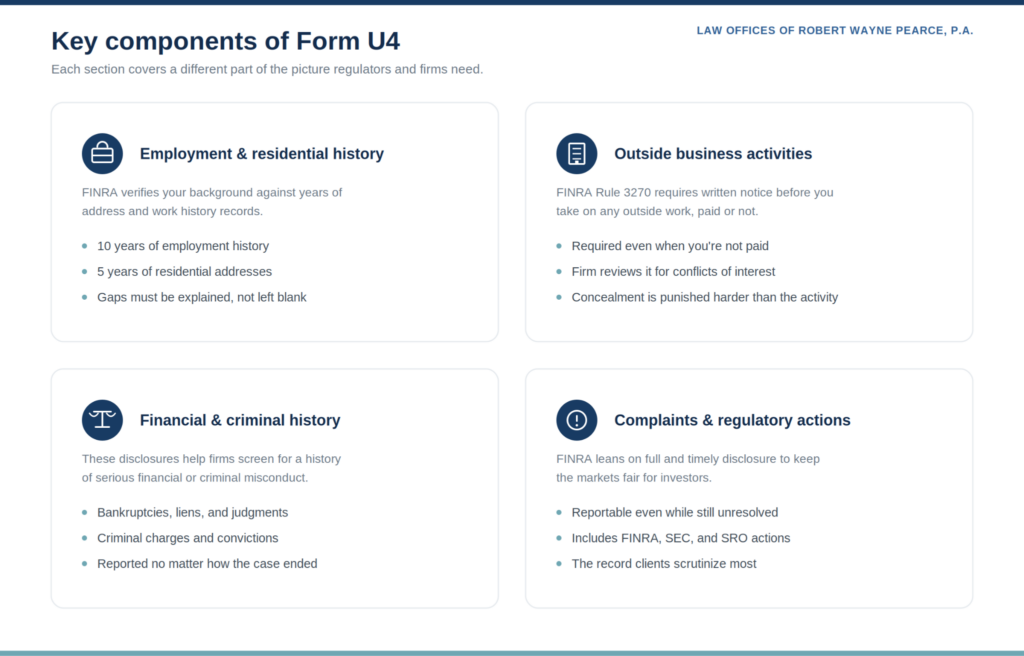
Form U4 is organized into sections covering identity, work history, and mandatory disclosures. Each section captures a different part of the picture regulators and firms need.
Employment and Residential History
Form U4 requires a complete employment and residential history. You need to explain any gaps, and FINRA wants up to ten years of employment history and five years of residential addresses.
Firms and regulators use this history, backed by supporting documentation, to verify your background. A complete record makes it harder to hide a problematic past behind vague or missing dates.
Outside Business Activity Disclosures
Form U4 requires you to disclose any outside business activity, paid or not. FINRA Rule 3270 requires written notice to your firm before you take on a side job, a consulting gig, or a board seat, even if you’re working for free.
Once you give notice, your firm has to evaluate whether the activity creates a conflict of interest or could look like part of the firm’s own business, and it can approve it, limit it, or shut it down entirely.
Undisclosed outside business activities are one of the most common triggers for FINRA enforcement. A real estate side hustle, an insurance side gig, even running an online shop on weekends, can turn into a real problem the moment it surfaces and you never disclosed it. Regulators tend to punish the concealment harder than the activity itself, so the safer move is always to over-disclose.
See our guide regarding FINRA Rule 3270 to learn more.
Financial and Criminal Disclosures
Form U4 requires financial disclosures such as bankruptcies and liens, along with criminal disclosures. Beyond finances, the form reaches your legal history. Certain criminal charges and convictions, along with civil litigation and civil cases, must be reported regardless of how the matter ultimately turned out, and these regulatory events shape a disciplinary history.
Financial events like bankruptcies within a defined lookback period are also reportable. These disclosures give a picture of financial responsibility that firms weigh when deciding whom to trust with client accounts.
The reason FINRA does this is that its entire mission is to protect investors and safeguard the integrity of the markets, and that starts with screening out people with a history of serious misconduct before they ever touch a client’s account.
Together, these events build the disciplinary history that firms and investors check before trusting someone with their money.
Customer Complaint and Regulatory Disclosures
The form requires disclosure of customer complaints, arbitrations, and regulatory actions. Customer complaints alleging sales practice violations are reportable even when they remain unresolved, which can feel unfair to a representative who believes the complaint is meritless.
Regulatory actions must be disclosed as well, whether they come from FINRA, the SEC, or other self-regulatory organizations. These regulatory bodies and regulatory authorities expect full regulatory information, and meeting those reporting requirements is part of a representative’s broader regulatory obligations.
FINRA’s whole job is to protect investors and keep the markets fair, so it leans hard on full and timely disclosure to pull that off.
Form U4 vs. Form U5: How They Work Together
Form U4 registers you with a firm, and Form U5 reports your departure, so the two documents bookend each period of employment. The U4 opens the registration, and the U5 closes it when you leave.
When you leave a firm, whatever termination reason your former employer reports on your U5 (voluntary, permitted to resign, or discharged for cause) can follow you straight into the U4 at your next firm. If your U5 says “discharged for cause,” your new firm sees that before you’ve even started the job.
Discrepancies between a U5 and a later U4 draw regulatory attention fast. When the two records tell different stories, it can trigger a regulatory inquiry, delay your registration approval by weeks or months, or land you under heightened supervision at your new firm. State regulators can flat out deny your registration application if the story doesn’t add up.
If a former employer slaps a false or unfairly harsh reason on your U5, fight it early. Our Form U5 lawyers help brokers dispute exactly this kind of language before it does lasting damage.
Update Deadlines
FINRA By-Laws Article V, Section 2(c) requires every U4 to stay current through amendments whenever a reportable event happens, like a new address, a customer complaint, or a criminal charge. These can all trigger the requirement, and the clock starts the moment you learn about it.
The 30-Day and 10-Day Rules
Most U4 amendments are due within 30 days of learning about the event. Anything tied to a statutory disqualification under Sections 3(a)(39) and 15(b)(4) of the Securities Exchange Act gets a tighter 10-day window. That shorter deadline exists because disqualifying events can end a registration outright.
Both the firm and the representative share responsibility for hitting these deadlines. Miss one, and that’s its own violation, separate from whatever triggered the amendment in the first place.
How Form U4 Affects Your Career
The information on your Form U4 can shape your career for years. Disclosures do not simply disappear once an event is resolved.
These entries become part of your permanent, public-facing record. Prospective employers review them closely before hiring, and an unfavorable disclosure can cost you opportunities before you ever reach an interview.
BrokerCheck and IAPD Visibility
Much of your Form U4 information appears publicly on FINRA BrokerCheck and the SEC’s Investment Adviser Public Disclosure system. Clients and employers can view your disclosures, employment history, and qualifications.
Inaccurate disclosures can damage your reputation even when the underlying event was minor. A single misreported item, visible to anyone who searches your name, can do lasting harm to how you are perceived.
Amending Form U4
Amending Form U4 is how registered persons keep their record accurate when circumstances change. The amendment process is also where inaccurate entries can be challenged.
Expungement of Inaccurate Disclosures
Expungement is the process for removing inaccurate or false disclosures from your Form U4 record. It generally requires a FINRA arbitration award or a court order directing the removal.
The standards for expungement are strict. You need documentation like account statements, correspondence, compliance records, and anything that contradicts the claim. Most people who try this without a lawyer get nowhere, because arbitrators scrutinize these requests heavily and FINRA itself can challenge the relief in court.
Why Accuracy Matters
Accuracy on Form U4 matters because errors and omissions carry serious regulatory and career consequences. Errors typically stem from failing to report or inaccurately disclosing the following:
- Personal Financial Matters: Unpaid tax liens, civil judgments, and bankruptcies are considered indicators of financial unsuitability. Even settling with a creditor for less than the owed amount must be disclosed.
- Customer Complaints: Any formal client disputes or arbitrations alleging misconduct must be reported, regardless of their perceived validity.
- Criminal Charges: Misdemeanors (including historical ones) and felony charges or convictions must be disclosed.
- Outside Business Activities (OBAs): Financial professionals must disclose any business ventures, board memberships, or outside employment, along with time and compensation details.
- Employment Terminations: Being fired or permitted to resign from a previous firm under allegations of misconduct requires reporting.
Willful failures to disclose can lead to statutory disqualification, which can terminate registration and end a career in the industry. Future employers weigh this heavily. Even unintentional mistakes can trigger investigations and reputational harm, so a careless error can cost far more than the original event ever would have.
How an Attorney Can Help
An attorney can help you respond to disclosure issues, pursue expungement, and protect your registration. These matters often hinge on details that are difficult to handle without experience.
A lawyer reviews your record, identifies inaccurate entries, and advises on how to correct them. For disputed disclosures, counsel can pursue expungement or defend you in a regulatory matter, giving you a path to protect the record your career depends on.
At The Law Offices of Robert Wayne Pearce, P.A., we provide financial advisor and broker representation nationwide to help you protect your registration, fix disclosure errors, and pursue expungement when something inaccurate is dragging your record down. Contact us for a consultation if you want a second set of eyes on a Form U4 issue or a broker’s regulatory record.