
A closed-end fund is a registered investment company that raises a fixed pool of capital through an initial public offering. A closed-end fund issues a fixed number of shares and then trades on a stock exchange like any other listed security. If you own one and have never been told how the price is set, you are in the same position as most of the investors who come to us.
The fund does not issue new shares when demand rises and does not redeem shares when you want out. Instead, closed-end fund shares change hands between other investors on an exchange such as the New York Stock Exchange, at whatever price the market will bear on any trading day.
Closed-end funds, or CEFs, as some listings abbreviate them, are a long-established structure. The fund’s investment strategy is set out before launch, and buying the fund’s shares on the exchange is the only way in.
They are actively managed and professionally managed portfolios, and the fund’s investment objectives are set out in a prospectus filed with the Securities and Exchange Commission.

How Do Closed-End Funds Work?
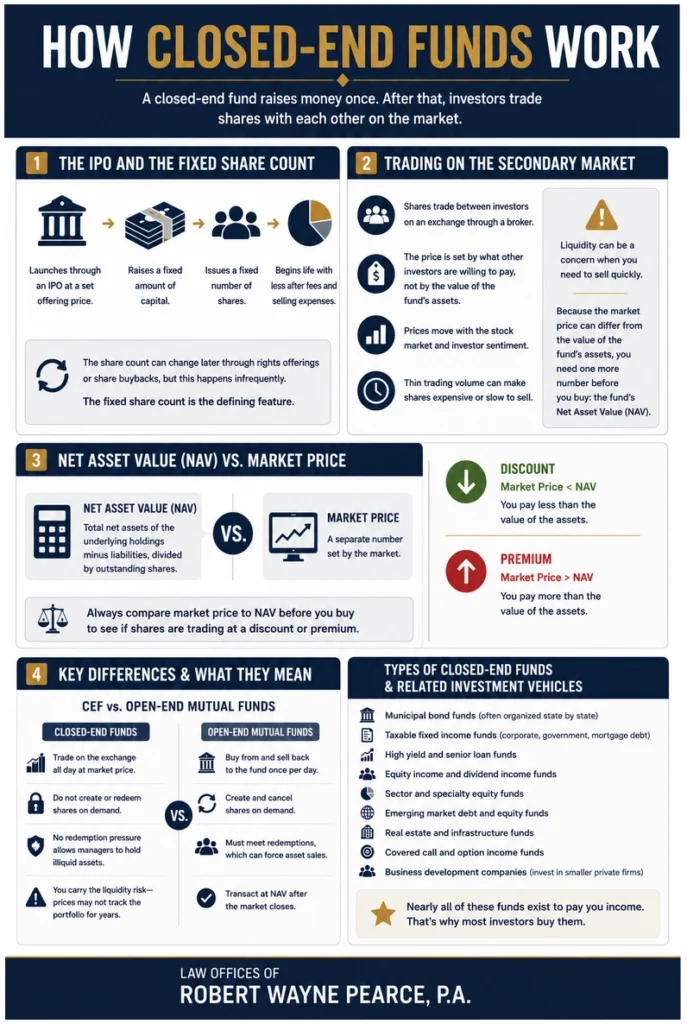
A closed-end fund raises money once, then investors trade the shares among themselves. The share price and the value of the portfolio behind it are therefore two separate numbers.
The IPO and the Fixed Share Count
A closed-end fund launches at a set offering price and raises a fixed amount of capital before the offering closes for good.
Where the sponsor pays the selling brokers out of those proceeds, the fund begins life holding less than the investors actually paid in. Rights offerings and share buybacks can change the count later, though neither happens often enough to rely on. That fixed share count is the defining feature of the whole structure.
Trading on the Secondary Market
From the day it lists, you buy and sell a closed-end fund through a broker on the secondary market. Unlike an open-end mutual fund, you generally trade with other market participants rather than redeeming your shares directly with the fund.
The price comes from what other people are willing to pay rather than from the value of the fund assets. A publicly traded CEF’s share price moves with the stock market and with investor sentiment, and thin trading volume makes some funds expensive or slow to sell.
Liquidity can be a real concern when you need to sell quickly. And because the market price can differ from the value of the fund’s assets, there’s one more figure you need to know before you buy: the fund’s net asset value.
Net Asset Value (NAV) vs Market Price
Net asset value is the total net assets of the underlying holdings minus liabilities, divided by the outstanding shares. A closed-end fund’s market price is a separate number set by the market. An open-end mutual fund transacts at NAV, and a closed-end fund does not.
A CEF trades at a discount when its market price is below NAV and at a premium when it is above NAV. Before you buy, compare the two to see whether the shares are trading below or above the value of the fund’s assets.
Why Closed-End Funds Trade at a Discount
If a fund trades below its net asset value, something about the manager, the fees, or the assets is keeping buyers away. Investors may distrust the management, or the fees may run high relative to peers, or the portfolio assets may be illiquid and hard to value.
A persistent discount is not automatically a bargain, and finding that out after you have bought is an expensive way to learn it. A discount can narrow, and that narrowing is where your investment return comes from if you buy well, but nothing forces a discount to close, and it can widen instead. Now look at the opposite case, because paying above net asset value carries its own cost.
Why Closed-End Funds Trade at a Premium
Paying a premium means handing over more than a dollar for every dollar of assets you receive. Buyers usually pay it because of the size of the distribution or the reputation of the manager.
High distributions may attract plenty of buyers. But if demand fades, the premium can narrow even when the fund’s portfolio has not lost value. Someone who bought at that premium can lose money simply because the market price moves closer to NAV.
Closed-End Funds vs Open-End Mutual Funds
Open-end funds create and cancel shares on demand, so you buy from the fund, and you sell back to the fund. Both transactions happen at the net asset value calculated after the market closes, while closed-end funds trade at a market price all day.
Freedom from redemption pressure lets a closed-end fund manager hold illiquid securities without worrying that a wave of withdrawals will force a sale at the worst moment. You carry the liquidity risk instead, and it shows up as a share price that may not track the portfolio for years at a time. The same structural difference also shapes what these funds are able to hold.
Types of Closed-End Funds and Related Investment Vehicles
Closed-end funds invest in many different asset classes. Some of them are:
- Municipal bond funds, often organized state by state for federal tax purposes
- Taxable fixed income funds holding corporate, government, or mortgage debt
- High yield and senior loan funds
- Equity income and dividend income funds
- Sector and specialty equity funds
- Emerging market debt and equity funds
- Real estate and infrastructure funds
- Covered call and option income funds
- Business development companies, which are structured similarly and invest in smaller private firms
Nearly all of these funds exist to pay you income, and that is why most people buy them rather than for capital appreciation.
What Are Interval Funds?
An interval fund is a registered closed-end fund that offers to repurchase shares from investors at set intervals rather than listing on an exchange. Brokers sometimes present them as ordinary closed-end funds without explaining the difference, and the difference is the part that will affect you.
Repurchase offers come round every three, six, or twelve months, and each one covers between five and twenty-five percent of the shares outstanding. Interval funds do not list on an exchange or trade on an over-the-counter market, so there is no market price and no discount to track.
The word limited is doing a great deal of work in that sentence. If more investors want out than the offer covers, everyone gets a slice, and you wait for the next window, which may be a full year away. A stressed market is exactly when everyone asks at once. Structure aside, one practice inside these funds does more to change your outcome than any of it.
How Closed-End Funds Use Borrowed Money
Many closed-end funds borrow money to increase the size of the portfolio, which magnifies whatever the underlying assets do next. A fund might borrow thirty cents for every dollar of investor capital and then invest the whole amount.
What Borrowing Does in a Rising Market
When the assets earn more than the cost of borrowing, the extra return flows through to shareholders and the distribution looks generous against anything else paying income.
The fund report gives you the borrowing level as a percentage of assets, and it is one of the first numbers to look for. Two funds holding similar bonds can behave very differently under stress if one borrows heavily and the other does not. Hold that picture in mind, because the same mechanism runs in reverse when prices fall.
What Borrowing Does in a Falling Market
Sometimes the same borrowing that lifted the distribution turns a modest decline into a serious one. That is a difficult thing to watch happen to money you were told was conservative.
Rising borrowing costs compress the spread that the whole strategy depends on to produce its income. A fund under that pressure often cuts the distribution before it cuts anything else, and that cut is usually the first thing you notice.
Benefits of Closed-End Funds
Used appropriately, the closed-end structure gives access to assets and strategies a daily-redemption fund cannot hold comfortably. The benefits are as follows:
- Access to illiquid securities and specialized asset classes
- Portfolio managers who are never forced to sell to meet redemptions
- The possibility of buying assets below their net asset value
- Regular, often monthly, distributions for investors who need income
- Intraday trading, so you know your execution price before you commit
- Actively managed portfolios in narrow asset classes that are hard to reach otherwise
Every one of those advantages has a matching risk behind it, so read the next list alongside this one.
Risks of Closed-End Funds and Their Effect on Investment Return
The same features that create the benefits create the risks, and your total investment return depends on all of them rather than on the distribution rate alone. The risks of closed-end funds are as follows:
- Market price can fall even when the portfolio does not, if the discount widens
- Borrowing amplifies losses as readily as it amplifies gains
- Thin trading volume can make it expensive or slow to sell shares
- Fees are frequently higher than comparable open-end or exchange-traded funds
- Distributions can be reduced or suspended without warning
- Part of your distribution may be your own capital coming back to you
- Buying at an IPO usually means paying more than the assets are worth
How Distributions Work and Where Return of Capital Comes From
A fund advertising a nine percent distribution rate may be earning five percent and returning four percent of your principal to make up the difference. The fund should disclose the sources of the distribution, so you can see whether part of that payment came from a return of capital.
The rule requires the fund to name three possible sources: net income, profits from selling securities, and paid-in surplus or other capital. That third one is return of capital, which means the fund is handing back money you already put in.
All three sources may appear as part of the same distribution payment, but the fund should disclose how the distribution was sourced. Return of capital shrinks the CEF’s assets, which shrinks future income and cash flow, which increases the pressure to return still more capital in the following period.
You can find the sources of every distribution on the written statement the fund must send with the payment, known as the 19a-1, and again in the annual report.
Here at the Law Offices of Robert Wayne Pearce, P.A., the cases that reach us often begin the same way. An investor discovers that a yield they relied on for living expenses was partly their own money. Knowing where a distribution comes from is only useful if you know where to look for it.
How to Read a Closed-End Fund Before You Buy It
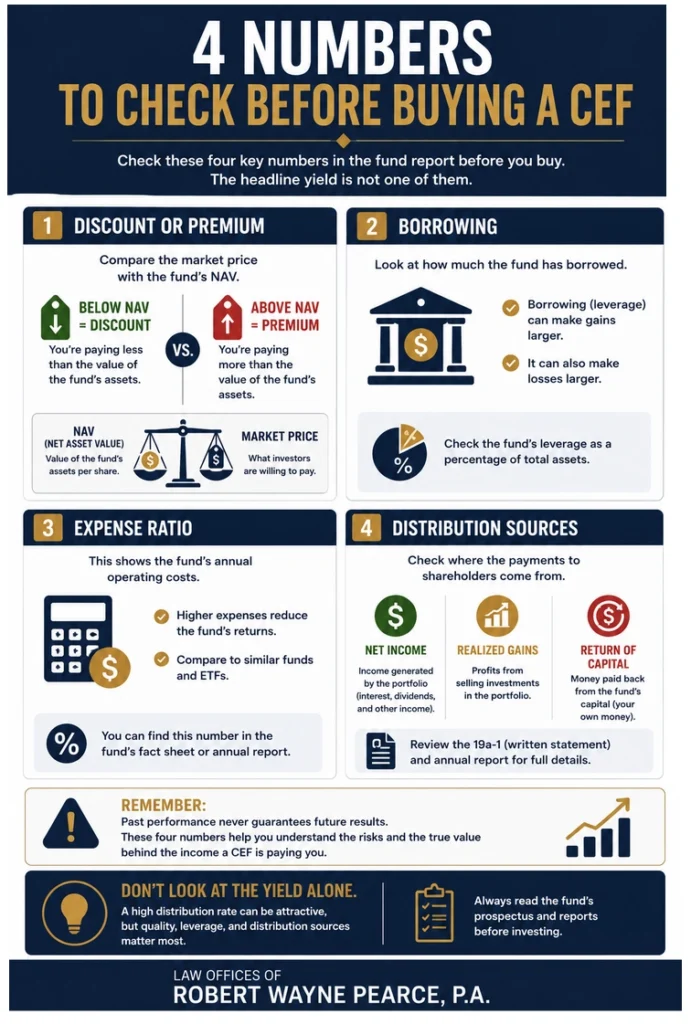
Check four numbers in the fund report before you buy. The headline yield is not one of them. If your broker has never walked you through these four, ask why:
- Discount or premium: Compare the market price with the fund’s NAV to see whether the shares are trading below or above NAV.
- Borrowing: Look at how much the fund has borrowed, since leverage can make both gains and losses larger.
- Expense ratio: This shows the fund’s annual operating costs and how those expenses can reduce your returns.
- Distribution sources: Check where the payments to shareholders come from, whether from income, gains, or a return of capital.
That fourth number changes what the investment actually is. The fund’s prospectus and its reports show how the fund’s NAV has moved against the fund’s market price over time, though past performance never guarantees future results.
Who Closed-End Funds Are For
Closed-end funds suit investors who need income, who can hold through a widening discount without being forced to sell, and who will read a fund’s prospectus before buying rather than after.
If you need the money back on a fixed date, or cannot absorb a fall in principal, this is the wrong product for you. They are a poor fit again where a broker has concentrated a large share of a retirement account into them. Concentration in a single fund family is the pattern that reaches our firm most often. If that description does not match how these funds were sold to you, the next section is written for you.
Talk to an Investment Fraud Attorney About Closed-End Fund Losses
If a broker put you into closed-end funds and you lost money, you may be able to recover it through FINRA arbitration. We understand how unsettling this is, particularly when the investment was sold to you as steady income. Learning that it was partly your own capital coming back is worse.
Here at the Law Offices of Robert Wayne Pearce, P.A., we have 45 years of experience representing investors and have recovered more than $185 million for our clients. Our success rate across litigation, arbitration, and settlements is 99%. We work on a contingency basis, so there is no fee unless we recover for you.
Claims like yours are heard in arbitration rather than in court, and time limits apply to nearly every kind of securities claim. Call us at (800) 732-2889 for a free consultation, speak with our investment fraud lawyers, or read more about closed-end fund risks and loss recovery.