
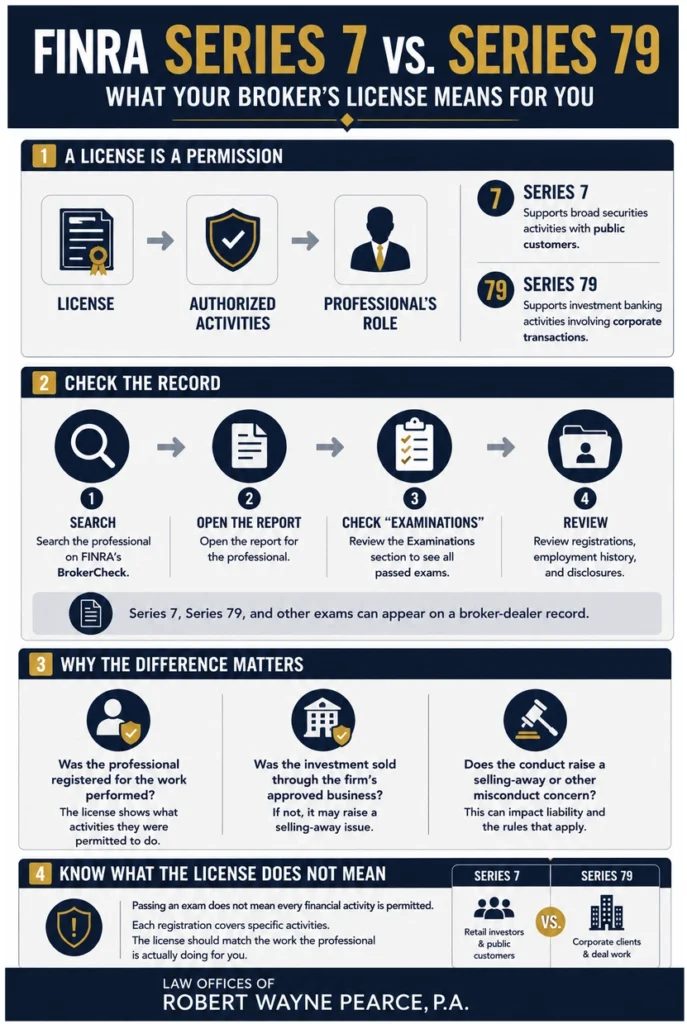
The Series 7 licenses a person to sell securities to the investing public, while the Series 79 licenses a person to advise companies on investment banking deals. Take the Series 7 if you want to recommend and trade stocks, bonds, and funds for retail customers at a broker-dealer. Take the Series 79 if you want to work on offerings, mergers, and restructurings for the companies issuing those securities.
The investment fraud lawyer team at the Law Offices of Robert Wayne Pearce, P.A. has spent 45 years representing investors, and we see how often the license behind a recommendation shapes the claim that follows it. In this guide, we explain what each license permits, how the two exams compare, which career path takes which exam, and how to check any professional’s licenses yourself.
What Is the Difference Between the Series 7 and the Series 79?
The Series 7 and the Series 79 are securities licensing exams from the Financial Industry Regulatory Authority (FINRA) that authorize two different jobs for a registered representative. A Series 7 holder works with the investing public, and a Series 79 holder works with the companies that issue securities.
One license is retail, and the other is corporate, which is why most investors meet Series 7 holders constantly and Series 79 holders almost never. The distinction sounds academic until money is lost, because the license determines what its holder was permitted to do, what rules governed the work, and which forum hears a dispute about it.
Both are top-off exams, built on the Securities Industry Essentials exam, the SIE exam FINRA requires as a corequisite before either registration becomes effective. If a person you invest with holds one of these licenses, the one they hold tells you what they are actually allowed to do for you. Because the licenses authorize different work, the place to start is what each holder can do.

What Can Each License Holder Do?
The two registrations authorize different activities, and neither substitutes for the other. FINRA defines both in its exam outlines, and the definitions draw the line clearly.
The Series 7: General Securities Representative
A Series 7 holder is a general securities representative, licensed to solicit orders and trade securities for public customers through a broker-dealer. That covers the full retail menu: stocks, bonds, options, mutual funds, exchange-traded funds and other investment company products. The firm may earn commissions or other transaction-related compensation, but that depends on its compensation structure.
The registration also allows the representative to open customer accounts, assess a customer’s financial profile and investment objectives, and carry out orders based on that information. FINRA’s exam outline reflects the range of activities covered by the registration.
Their recommendations are governed by Regulation Best Interest, the SEC rule requiring a broker to act in your best interest at the time a recommendation is made. You can read how this license compares with the adviser side in our Series 65 vs. Series 7 guide.
The Series 79: Investment Banking Representative
The Series 79 qualifies professionals for the investment banking representative registration, which covers debt and equity offerings, mergers and acquisitions, tender offers, financial restructurings, and asset sales. FINRA’s own exam outline defines the role in exactly those terms, and the definition is worth reading closely.
Notice who the client is: the issuing company rather than the investor, which is why most retail investors never deal with a Series 79 holder directly. Their work still reaches you, though, through the securities that the deal work produces.
When a company sells bonds to fund an acquisition, an investment banking representative structured that offering, priced it, and prepared the disclosure investors later relied on. Investment bankers are the start of the chain that ends in your portfolio.
Day-to-Day Responsibilities of an Investment Banking Representative
The day-to-day work behind the Series 79 involves core investment banking functions rather than customer accounts. It covers offerings, M&A, and financial restructuring.
Debt and Equity Offerings and Private Placements
The offerings half is underwriting: registered public offerings of debt and equity, and private placements sold to investors under an exemption from registration. Equity securities offerings range from initial public offerings to follow-on sales, while debt work runs from investment-grade bonds to the high-yield issues that fund riskier companies. Investment bankers run both ends of that range.
We recommend noting the Series 82 here too, the private securities offerings representative license, since that narrower registration covers private offerings alone.
Series 79 representatives can participate in private and public offerings as part of their investment banking activities. Other registered representatives may handle the solicitation or sale of the investment to customers. If you lost money on a private placement, you need to look at who recommended or sold the investment and what role the firm played in the transaction.
Mergers, Acquisitions, and Financial Restructuring
The other half of the job is mergers and acquisitions, tender offers, and financial restructuring transactions. The investment banking activities FINRA lists include advising the buyer or the seller, valuing the target, and running the tender process when one company bids for another’s shares.
FINRA Series 79 exam reflects these areas too. Of its 75 scored questions, 37 focus on data analysis and evaluation, 20 on underwriting and new financing, and 18 on M&A, tender offers, and financial restructuring.
Restructuring work includes distressed companies, which is the corporate end of events investors usually experience as losses. A financial restructuring reshapes what a company owes and to whom, through exchanges, amendments, or asset sales, and bondholders usually come out holding something different from what they bought. The banker advising the company and the investor holding its bonds are on opposite sides of the same transaction.
How Hard Is Each Exam?
Both exams are entry gates rather than rankings, and each tests the knowledge for its own job. FINRA’s exam pages publish no pass rate for either, and difficulty comparisons between them are mostly folklore, because almost nobody takes both exams under the same conditions. The figures below are FINRA’s own, from its exam pages.
The Series 7 Exam at a Glance
The Series 7 runs 125 scored questions over 225 minutes, requires 90 correct answers to pass, and costs $395. Candidates must also pass the Securities Industry Essentials exam as a corequisite.
A FINRA member firm has to sponsor the candidate by filing a Form U4, which opens the testing window. In practice, that means no job offer, no Series 7. The exam covers the whole span of the job, from seeking business and opening accounts through recommendations and records, and we will come back to why that span shapes claims.
The Investment Banking Representative Exam at a Glance
The investment banking representative exam runs 75 questions over 2 hours and 30 minutes, with a passing score of 73 and a $395 fee. You will find the SIE corequisite and firm sponsorship requirements are the same, and the exam has run in this form since November 2009.
It is a shorter test than the Series 7 but a narrower and deeper one, which is why the question of which is harder has no single answer. The 79 concentrates its 75 questions on deal work while the 7 spreads 125 across the whole retail job, so each is hard in the direction of its own work. Which raises the question candidates actually search: do you need one before the other?
Do You Need the Series 7 to Take the Investment Banking Exam?
You do not need the Series 7 to take the investment banking exam, because the Series 79 is a complete registration path on its own with the SIE corequisite.
Neither license is a prerequisite for the other, and neither expires while the holder remains registered. The two cover different ground, so passing one earns no credit toward the other, and a professional who needs both simply takes both. One thing we want you to keep straight is that firms decide which registrations a role requires, while FINRA’s rules decide what each registration permits.
Plenty of professionals at full-service firms hold both, since a banker who also deals with public customers needs the retail license too. A firm registers its people for whatever their actual role requires, and the registrations accumulate on the record over a career. What a candidate does need, for either exam, is the firm itself, because FINRA only tests people a member firm has put forward. The choice between the two exams is really a choice between two careers.
Career Path: Which License Fits Which Job in the Financial Services Industry?
The career path decides the exam, and the decision is usually made by the employer rather than the candidate. Retail brokerage, wealth management, and sales and trading desks in the financial services industry run on the Series 7, while investment banking analyst and associate roles run on the Series 79.
Both paths into the financial industry start the same way: a firm hires you, sponsors you, and files the paperwork before you can sit for anything. That differs from the adviser-side Series 65, which anyone can take without a sponsor. Series 7 roles generally involve serving investors through a broker-dealer, while Series 79 roles focus on investment banking, capital markets, and corporate finance work such as capital raising, mergers, and restructuring.
A professional who switches desks later, from banking to retail or back, usually takes the other exam at that point. The record keeps every exam either way, which is what makes it readable years later.
Other FINRA Exams You May See on a Broker-Dealer Record
A broker-dealer record usually carries more than one exam. The SIE appears on nearly every recent record, and FINRA’s own page notes that a passed SIE remains valid for four years on its own. The Series 63 and Series 66 are state-law exams that most states require alongside the federal licenses.
The Series 65 qualifies investment adviser representatives, and our Series 65 vs. Series 7 guide covers that side of the line. You may also see the Series 82, which covers private securities offerings alone.
An exam list reads like alphabet soup until you know that each entry is a permission. Because each exam is a permission, the list also tells you what someone was never permitted to do. Someone with only a Series 79, for example, was not qualified for the broad securities activities covered by the Series 7, while a Series 65 alone does not qualify them to sell securities as a broker.
What the License Difference Means When You Lose Money
When an investment goes wrong, the person’s registration can help show what activities they were qualified to perform and which rules may apply to their conduct. A Series 7 representative answers for specific recommendations under Regulation Best Interest, and claims against them and their firm are heard in FINRA arbitration.
What matters is whether the person was properly registered for the work they performed. If a registered person sells an investment outside their firm’s approved business, that may raise a selling-away issue. Many investors we speak with only check what their broker was registered to do after something has gone wrong.
Here at the Law Offices of Robert Wayne Pearce, P.A., we have spent over 45 years bringing these claims, with more than $185 million recovered for our clients.
How to Check Which Licenses Your Professional Holds
BrokerCheck, FINRA’s free public database, helps investors review the exams and registrations held by financial professionals. Search the name, open the report, and read the Examinations section: the Series 7, Series 79, or both will be there, along with employment history and any disclosures. There is a second database for the adviser side, the SEC’s Investment Adviser Public Disclosure, and it works the same way.
Checking takes about five minutes, and it is worth doing before you invest rather than after the first loss. The report is free to pull, and reading it requires no account or registration.
The Examinations section is printed alongside the disclosure history, so one search answers both what the person may do and what they have been accused of. What the record shows and what it means for your money are different questions, and the second one is where we can help.
So, which license should the person handling your money hold? The honest answer is whichever one matches the work they are actually doing for you.
Contact Our Investment Fraud Attorneys
If you lost money and something about how the investment was sold to you never sat right, the seller’s licenses are one of the first things worth checking. We understand how unsettling it is to discover that the person you trusted was operating outside what their registration allowed.
Here at the Law Offices of Robert Wayne Pearce, P.A., we have 45 years of experience representing investors and have recovered more than $185 million for our clients. Our success rate across litigation, arbitration, and settlements is 99%. We work on a contingency basis, so there is no fee unless we recover for you.
Call us at (800) 732-2889 for a free consultation, speak with our investment fraud lawyers, or read about FINRA arbitration and what to expect.