
Unauthorized trading is a broker buying or selling in your investment account without your permission and without the written authority to trade on their own.
In a Ponzi scheme, the fraud is the investment itself, but here the fraud is the decision: someone else made it in your account.
If a trade confirmation has ever arrived for a transaction you do not remember approving, you have seen how this problem announces itself.
In this guide, our investment fraud lawyer team will walk you through what unauthorized trading is and what the FINRA rules require. We also cover how discretionary accounts change the answer, and how to spot unauthorized transactions on your statements.
What Is Unauthorized Trading?
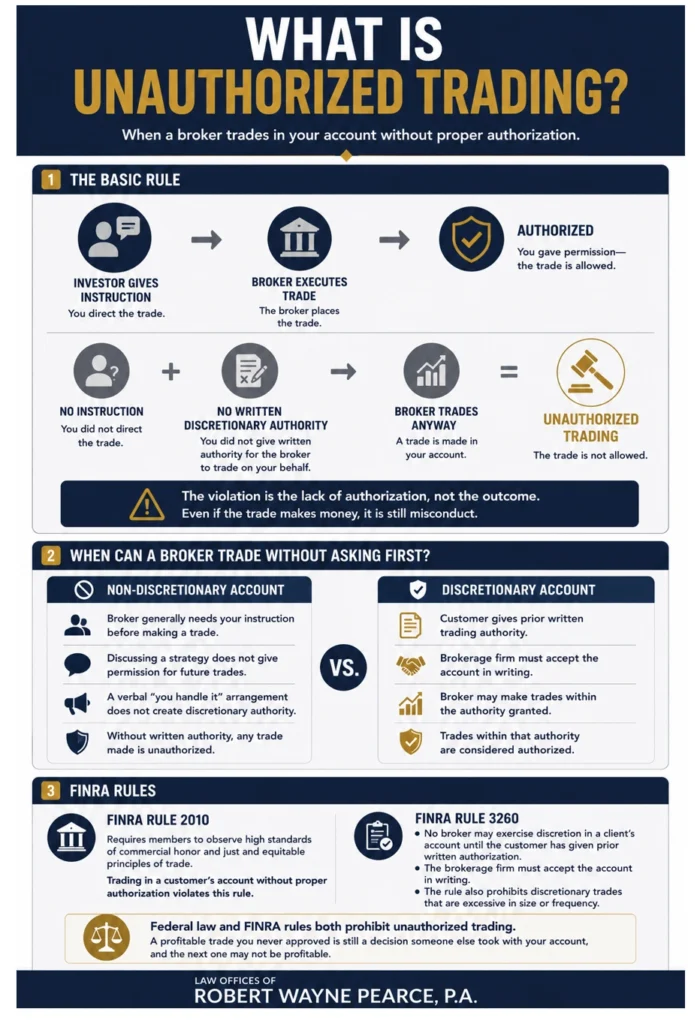
Unauthorized trading happens when a broker or financial advisor places a trade in a customer’s account without instruction and without written discretionary authority. You gave that instruction either by directing the trade yourself or by signing a discretionary agreement beforehand. Outside of that, the trade was not the broker’s to make.
The violation is the missing permission rather than the outcome, so an unauthorized trade is misconduct even when it makes money. Any financial harm it causes may be the firm’s to answer for.
A profitable trade you never approved is still a decision someone else took with your account, and the next one may not be profitable. Federal law and FINRA rules both reach this conduct, from different directions. Because the rules are specific, it helps to see what they actually require.
What the Financial Industry Regulatory Authority Rules Say
The Financial Industry Regulatory Authority treats unauthorized trading as a violation of FINRA Rule 2010, which requires members to observe high standards of commercial honor and just and equitable principles of trade. Trading a customer’s account without proper authorization fails that standard on its face.
FINRA Rule 3260 adds the specifics for discretionary accounts: no broker may exercise discretion in a client’s account until the customer has given prior written authorization and the brokerage firm has accepted the account in writing. Obtaining authorization first, in writing, and getting the firm’s acceptance is the rule’s whole point.
The same rule bans discretionary trades that are excessive in size or frequency, which is where unauthorized trading meets excessive trading. We advise complaining promptly and in writing when a transaction you did not approve appears, because a dated written objection anchors everything that follows. So when exactly is a broker allowed to trade in your account without asking first?
Discretionary vs. Non-Discretionary Investment Accounts
A broker can trade without calling you first if you have a discretionary account, one where you’ve granted written trading authority and the firm has approved it. The SEC notes that a broker may be able to sell securities in a margin account without consulting you if the account falls below the firm’s requirements.
But in other investment accounts, the broker needs your instruction before making a trade. It doesn’t matter what strategy you and the broker have already discussed.
Our guide to discretionary and non-discretionary accounts covers how to choose between them. The line itself is the point: a verbal “you handle it” habit does not create discretionary authority, however friendly the relationship. Many investors believed a standing phone arrangement counted as permission. It does not, and that paperwork failure belongs to the firm rather than to you.
How to Spot Unauthorized Transactions on Your Account Statements
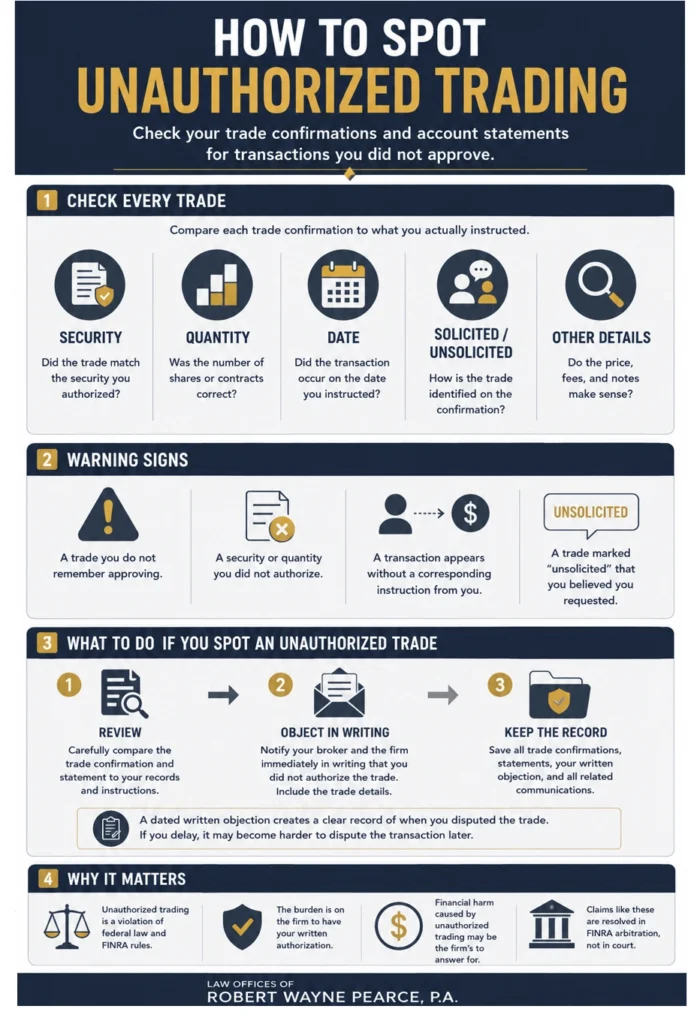
Your account statements and trade confirmations are where unauthorized transactions surface, usually within days of the trade. If you suspect unauthorized trading, we recommend reading each confirmation against what you actually instructed:
- the security
- the quantity
- the date
- whether the trade is marked solicited or unsolicited
If a trade you authorized is marked as unsolicited, that can raise questions. The best thing to do is object in writing the moment you see a trade you did not approve, and keep a copy. Because if you delay, it may become harder to dispute the trade later.
Contact Our Investment Fraud Attorneys About Unauthorized Trading
We understand how unsettling it is to find your account did things without you. The firm may argue you consented, and the paper record decides that argument.
Here at the Law Offices of Robert Wayne Pearce, P.A., we have 45 years of experience representing investors and have recovered more than $185 million for our clients. Our success rate across litigation, arbitration, and settlements is 99%. We work on a contingency basis, so there is no fee unless we recover for you.
Claims like these are heard in FINRA arbitration rather than in court. Call us at (800) 732-2889 for a free consultation, or read more about unauthorized trading claims and recovery.