

When you open a brokerage account, your firm collects a surprising amount of information about you. FINRA Rule 4512 is the regulation that governs what they must collect, how long they must keep it, and why those records matter for your protection.
Understanding this rule helps you see what your firm owes you, and it can help you spot when sloppy recordkeeping has put your money at risk.
What Is FINRA Rule 4512?
FINRA Rule 4512 requires broker-dealers to collect and maintain essential information about every customer account. The rule sets a baseline for accurate recordkeeping so firms can serve clients properly and respond to regulators when asked.
At its core, the rule is about having the right facts on file. Firms must gather identifying details, account authorizations, and the information needed to judge whether their advice fits the customer. These records form the foundation for nearly everything else the firm does on your behalf, from securities transactions to supervision, and they support the firm’s compliance with its broader obligations.
The rule applies to all FINRA-registered broker-dealers and their associated persons. Brokerage firms, broker-dealers, and other financial institutions that hold customer accounts all fall within its reach. And the reach is broad on purpose because your account information is what keeps the entire suitability and supervision system running.
Why Rule 4512 Exists
Rule 4512 exists to protect investors and to give regulators a reliable record of how accounts are handled. Accurate information is what lets a firm recommend suitable investments and detect problems before they grow.
When FINRA or the SEC investigates a firm, your account file lets them piece together what happened and whether the firm did its job. If you cut that paper trail, misconduct gets a lot easier to hide.
There is an investor-protection layer here, too, aimed at protecting vulnerable investors. Well-kept records help firms identify red flags, including signs that someone may be taking advantage of a vulnerable customer.
What Customer Information Firms Must Collect
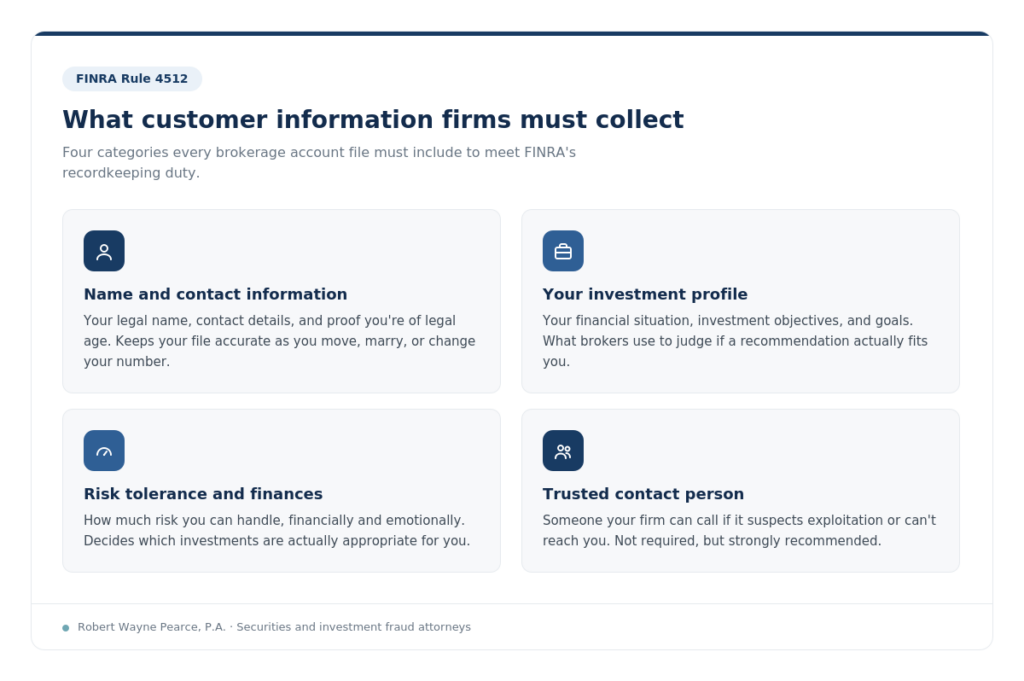
Firms must collect a defined set of customer details when opening and maintaining an account. The rule frames these as the essential facts needed to service the account and meet regulatory duties.
Name and Contact Information
Your firm must obtain and keep current your name and contact information, along with confirmation that you are of legal age. This sounds basic, but it is the anchor for every other record tied to your account.
Keeping this information accurate is an ongoing duty, not a one-time task at account opening. If you move, change your number, or get married and change your name, your firm has to update its records as part of normal business. The firm is expected to update its records in the course of its routine business, so the file always reflects who you actually are and how to reach you.
The Customer’s Investment Profile
Your firm must gather the information that makes up your investment profile, including your financial situation, investment objectives, and other facts relevant to your account. This profile is what brokers rely on when deciding whether a recommendation suits you.
You may be feeling that these questions are intrusive when you first open an account, and that reaction is understandable. The rule exists because whatever recommendation they give you should reflect your real situation, not random recommendations.
Risk Tolerance and Financial Circumstances
Risk tolerance reflects how much investment risk you are willing and able to accept, and your firm must account for it alongside your broader financial picture. Risk tolerance comes down to how much investment risk you can handle, both financially and emotionally. Your firm has to weigh that against your broader financial picture, and together those factors decide which investments actually fit you.
Get this wrong, and the fallout can be serious. Say you’re a conservative investor, but your file lists you as aggressive. You could end up holding products that never fit your needs, and that mismatch often becomes the basis for a later claim.
The Trusted Contact Person Requirement
Rule 4512 requires firms to make reasonable efforts to obtain a trusted contact person for each non-institutional account. The trusted contact provision is built specifically around these non-institutional customer accounts. A trusted contact is someone the firm can reach out to in specific situations involving your account.
The requirement grew out of concern about financial exploitation, especially of senior investors, and elder financial exploitation of specified adults is exactly the harm it targets. By having a trusted contact on file, a firm gains a way to check in when something looks wrong, including signs of diminished capacity, before any real damage is done.
Not naming a trusted contact won’t stop your firm from opening or keeping your account open. Firms only have to make a reasonable effort to ask. You’re never forced to name someone you don’t want to.
What a Trusted Contact Can and Cannot Do
A trusted contact can be contacted to address possible financial exploitation, confirm your current contact information, or identify a legal guardian or power of attorney. The role is narrow and protective by design.
Naming someone doesn’t hand them authority over your account, access to your assets, or the power to make trades. Your firm keeps this contact on file so they have someone to call. They’re simply a point of contact, and they have to be a real person at least 18 years old.
Why Firms Request a Trusted Contact
Firms request a trusted contact because it gives them a responsible person to reach when they cannot reach you or when they suspect something is wrong. Sometimes a customer goes quiet after a move, a long trip, or a health event, and the trusted contact becomes a way to confirm everything is fine.
The requirement opens the door to a conversation you might not have otherwise. When your firm asks for a trusted contact, it gives you both a chance to talk through how to protect your account from scams before anything goes wrong.
Rule 4512 and Senior or Vulnerable Investors
Rule 4512 carries special weight for senior and vulnerable investors, who are frequent targets of financial abuse. The trusted contact requirement and the emphasis on accurate records are aimed squarely at protecting this group.
Older investors control a massive share of the wealth in this country, and scammers know it. The FTC’s December 2025 report to Congress found that adults 60 and older reported losing $2.4 billion to fraud in 2024, up 26% from the year before, with investment scams driving the biggest losses of any category. Because most fraud goes unreported, the real number is almost certainly higher.
Rule 4512 gives firms better tools to spot exploitation early and a trusted contact to call when something looks off. States add their own layer on top of that.
Under Florida’s Protection of Specified Adults law (Fla. Stat. § 517.34), securities dealers and investment advisers can delay a transaction or disbursement for a specified adult, meaning anyone 65 or older, or a vulnerable adult of any age with a qualifying impairment. Texas’s Securities Act lets dealers freeze suspicious transactions in a vulnerable adult’s account too.
If you suspect someone you love has already been targeted, whether in Florida, Texas, or anywhere else, our elder financial abuse attorneys can help you figure out what happened and what to do next.
How the Rule Helps Prevent Financial Exploitation
The rule helps prevent exploitation by combining good records with a designated person the firm can alert. When a firm spots an unusual disbursement request or a sudden change in behavior that points to suspected financial exploitation, the trusted contact gives them somewhere to turn before money leaves the account.
This preventive function works hand in hand with other FINRA rules. The information collected under Rule 4512 is what makes early detection possible, turning a pile of account records into an actual safeguard for people who need it most.
Account Types Under Rule 4512
Rule 4512 treats different account types differently, and knowing which category you fall into clarifies what the firm owes you. The main distinctions involve institutional versus non-institutional accounts and the special handling of discretionary accounts.
Non-Institutional vs. Institutional Accounts
Non-institutional accounts, which include most individual investors, carry the full set of requirements, including the trusted contact provision. These are the accounts the rule’s investor-protection features are built around.
Institutional accounts are treated differently and may be exempt from certain requirements like the trusted contact. The rule automatically counts banks, insurance companies, registered investment companies, and registered investment advisers as institutional accounts. Any other person or entity qualifies too, as long as they hold at least $50 million in total assets. The idea is that these account holders are sophisticated enough not to need the same protections.
Discretionary Account Requirements
Discretionary accounts, where your broker can trade without getting your approval for each transaction, come with added requirements. Because the broker holds more power, the firm must keep detailed records and obtain clear authorization for that discretion.
The firm must also ensure that discretionary trades align with your stated objectives and risk tolerance. That tie back to your investment profile is what keeps a discretionary broker accountable. Since 2019, FINRA has permitted electronic signatures for these authorizations instead of requiring a manual one.
How Long Firms Must Keep Customer Records
Firms must preserve customer account information for at least six years, and the rule is specific about how that period is measured. FINRA splits this into maintaining and preserving. Maintain covers information that’s current and in active use. Preserve covers information that’s no longer current but still has to stay on file. Either way, your firm holds onto the last update, or the original info if nothing ever changed, for at least six years after your account closes.
Six years sounds like a long time, but it matters because if you ever need to prove what your firm knew and when, those preserved records are often the evidence that decides the question.
How Rule 4512 Connects to Other FINRA Rules
Rule 4512 works as part of a network of FINRA rules that together govern how firms know their customers and protect them, and two connections stand out.
Rule 2090 (Know Your Customer)
FINRA Rule 2090, the Know Your Customer rule, requires firms to use reasonable diligence to understand the essential facts about every customer. The information collected under Rule 4512 is what feeds that obligation.
Rule 4512 and Rule 2090 work as a pair. Rule 4512 dictates what to collect and keep, while Rule 2090 dictates how firms must use that knowledge to supervise the account. A failure in one area often signals a failure in the other.
Rule 2165 (Financial Exploitation of Seniors)
FINRA Rule 2165 lets firms place temporary holds on disbursements, and since a 2022 amendment, on securities transactions too, when they reasonably suspect financial exploitation of a specified adult. The initial hold runs 15 business days, and firms can extend it up to 55 days total if they report the matter to a regulator. It is the action arm to Rule 4512’s information-gathering role.
Together, these two rules cover both sides of the problem. Rule 4512 gets the firm a trusted contact and accurate records on file. Rule 2165 gives it the power to pause a suspicious transaction and call that contact.
An investment fraud attorney can regularly check whether a firm actually used these tools when an older investor loses money to exploitation.
Common Rule 4512 Violations and Consequences
Firms violate Rule 4512 when they fail to collect required information, fail to keep it current, or fail to make reasonable efforts to obtain a trusted contact. Recommending investments without understanding a client’s situation is among the most damaging failures.
In such cases, FINRA may impose fines, suspensions, or even permanent bars, and firms with recordkeeping deficiencies often face heightened scrutiny and more frequent audits going forward.
Beyond the regulatory penalties, poor recordkeeping can directly harm you. When a firm acts on incomplete or inaccurate information, the resulting recommendations may be unsuitable, and the losses that follow can become the basis for a claim.
What Investors Can Do If Their Information Was Mishandled
If you suspect your account information was mishandled, start by requesting your account records and reviewing what your firm actually had on file.
Look closely at whether your stated objectives and risk tolerance match the investments you were placed in. When the recommendations clash with your recorded profile, or when no accurate profile exists at all, the firm may have fallen short of its Rule 4512 duties.
We recommend that you keep copies of everything, including statements, account forms, and any communications about your investments. This documentation is what an attorney needs to evaluate whether a recordkeeping failure contributed to your losses.
How an Attorney Can Help
An experienced securities attorney can determine whether a firm’s recordkeeping failures played a role in your losses and whether you have grounds for a claim. These cases often hinge on details that are difficult to spot without knowing how the rule works.
A lawyer can request and analyze your account records, compare them against the investments you held, and identify where the firm departed from its obligations. From there, they can advise you on pursuing recovery through FINRA arbitration if the facts support it.
If you believe inaccurate or incomplete account information contributed to your financial harm, contact us today to clarify your options. Understanding your rights under Rule 4512 is the first step toward holding a firm accountable for the records it was required to keep.