
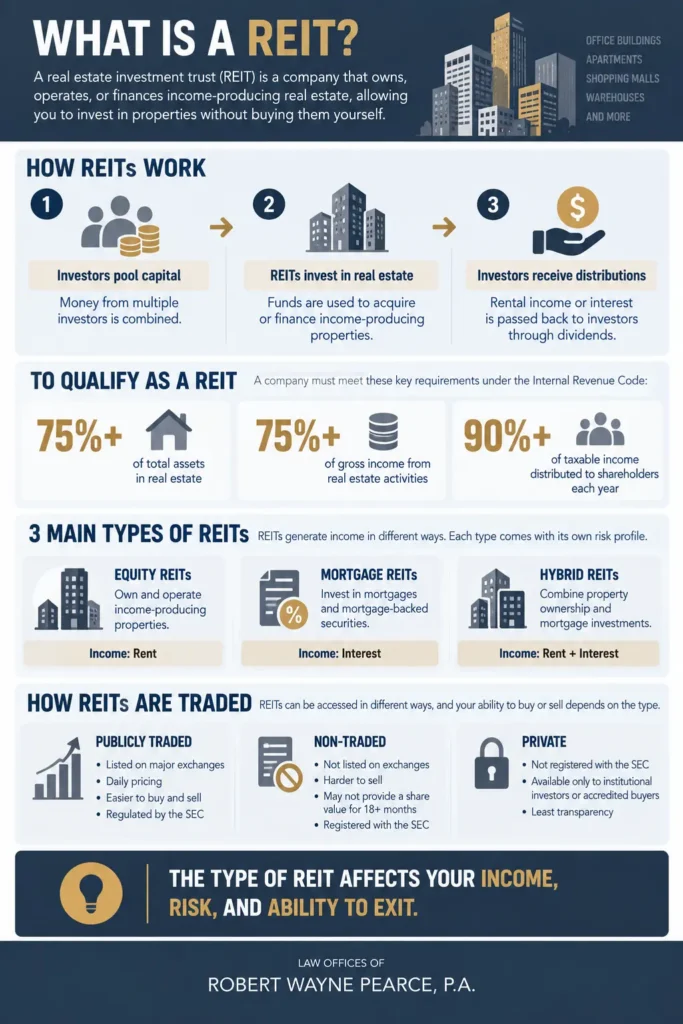
A REIT is a company that owns, operates, or finances income-producing real estate and must distribute at least 90% of its taxable income to shareholders each year.
Real estate investment trusts work by pooling capital from individual investors and using it to acquire or finance properties like office buildings, apartments, warehouses, and shopping malls, then distributing the rental income or interest back to those investors.
They can be good investments if they match your risk tolerance, time horizon, and income goals, and publicly traded REITs have delivered strong total returns over long periods. But REITs also carry real risks, particularly non-traded and private REITs, and they remain a ripe opportunity for investment fraud by dishonest brokers and financial advisors.
In this guide to real estate investment trusts, we will cover what REITs are, the different types of REITs, the benefits and risks of REIT investing, how investors lose money in REITs, and how to invest safely, as well as how to stay safe from fraud and what to do if you suspect your stockbroker has defrauded you.
What Is a REIT?
A REIT is a real estate investment structure that allows investors to own a share of properties that generate income or other real estate-related assets and receive distributions from them.
Congress established REITs in 1960 to give individual investors a way to invest in large-scale commercial real estate without purchasing property on their own. Before that, the only way to profit from office buildings, shopping malls, or apartment complexes was to buy them outright, which put real estate investing out of reach for most people.
Today, real estate companies structured as REITs finance real estate acquisitions using pooled investor capital and pass the returns back through dividends.
To qualify as a REIT under the Internal Revenue Code, a company must invest at least 75% of its total assets in real estate, derive at least 75% of its gross income from real estate activities, and distribute at least 90% of its taxable income to shareholders each year.
In exchange, the REIT avoids paying corporate income tax at the entity level. Public-traded REITs trade on major stock exchanges just like ordinary stocks, which means you can buy and sell shares through a standard brokerage account alongside mutual funds, bonds, and other asset classes.
If you have never invested in real estate before, we understand how the number of REIT types and structures can feel overwhelming at first.
Are REITs a Good Investment?
REITs can be a good investment for some investors, as they can be a strong addition to a diversified portfolio when they match your goals, timeline, and risk tolerance. But they also come with risks that you should understand before investing. That’s why a REIT’s risks and potential returns should be considered alongside how it was recommended and whether it suits your financial goals.
If a broker recommended a REIT that was unsuitable for your situation, or if you have been unable to liquidate a non-traded REIT, don’t assume nothing can be done. An experienced securities attorney can evaluate your account records and determine whether you have grounds to pursue recovery through FINRA arbitration.
Types of REITs
Real estate investment trusts fall into several categories based on how they generate income and how their shares are bought and sold.
The distinctions between these types affect your returns, your risk exposure, and your ability to exit the investment. Investors access REITs through individual REIT stocks, real estate funds, or exchange-traded fund products depending on how much diversification they want.
Equity REITs
Equity REITs own and operate income-producing real estate such as office buildings, shopping malls, apartments, warehouses, and data centers. Revenue comes primarily from rental income collected from tenants rather than from reselling real estate properties. Many equity REITs specialize in a single property sector, while others hold diversified portfolios across residential properties, commercial real estate, and industrial facilities.
Equity REITs make up the largest share of the publicly traded REIT market and offer investors both steady income through cash flow distributions and potential for long term capital appreciation as property values increase over time. If you are looking for a REIT that generates returns from actual property operations, equity REITs are the most common starting point.
Mortgage REITs
Mortgage REITs invest in mortgages and mortgage-backed securities rather than owning physical real estate properties. Income comes from the interest earned on these mortgage investments, which is often referred to as the net interest margin.
Mortgage REITs tend to pay higher dividend income than equity REITs, which attracts investors looking for above-average yields and steady income. However, that higher payout comes with a tradeoff. Because their earnings depend on the spread between short-term borrowing costs and long-term interest rates, mortgage REITs are significantly more sensitive to interest rate changes and capital markets fluctuations than their equity counterparts. We recommend that you understand this sensitivity before adding mortgage REITs to your portfolio.
Hybrid REITs
Hybrid REITs combine the strategies of both equity REITs and mortgage REITs in a single portfolio. These REITs hold physical real estate assets while also investing in mortgages, which allows them to earn from both rental income and interest income simultaneously.
The goal is to balance the risks of each approach, though hybrid REITs remain subject to both real estate market downturns and interest rate pressures. Since hybrid REITs face both types of risk, check what the REIT invests in before you buy.
Publicly Traded vs. Non-Traded vs. Private REITs
Public REITs that are listed on major stock exchanges give investors daily pricing, transparency, and the ability to sell REITs at any time during market hours. Listed REITs are regulated by the SEC and must file regular financial disclosures. Non-traded REITs tell a different story.
Public non-traded REITs are registered with the SEC but do not trade on national securities exchanges, which makes them difficult to sell and harder to value. Many non-traded REITs do not provide an estimated share value for 18 months or longer after the offering closes.
Private REITs are exempt from SEC registration entirely and are available only to institutional investors or accredited buyers, with the least transparency of any REIT structure. You should know the differences between these categories before you commit any capital, because your ability to exit the investment depends entirely on which type you own.
Benefits of Investing in REITs
REITs give individual investors access to commercial real estate income, portfolio diversification, and potential inflation protection without the cost of buying property directly.
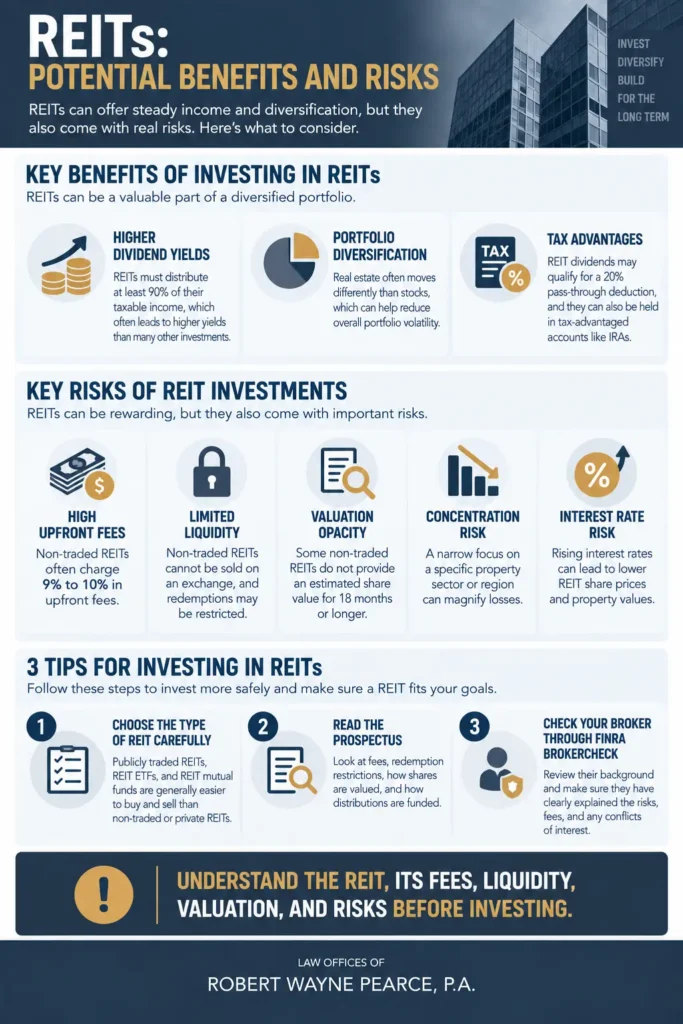
REITs generally offer higher dividend yields than many other asset classes because they must distribute at least 90% of taxable income. That requirement creates a reliable income stream that has made REIT investments popular among retirees and income-focused investors for decades.
- Higher dividend yields: Because of the 90% distribution requirement, REIT dividends often exceed what you would earn from traditional equities. Investors can track broad performance through benchmarks like the equity REITs index to compare yields across property sectors.
- Portfolio diversification: Real estate often follows a different cycle than the stock market, which can reduce overall portfolio volatility when you hold REITs alongside stocks and bonds. REITs also provide exposure to emerging markets and international real estate values that may move independently of domestic equities.
- Tax advantages: REIT dividends may qualify for a 20% pass-through deduction under current tax law, and holding REIT investments in tax-advantaged accounts like IRAs can further reduce the tax burden on your dividend income.
Risks of REIT Investments
If interest rates rise sharply, REIT share prices and property values can both decline at the same time, compressing returns from two directions.
Over the past few years, market volatility driven by rate hikes has reminded investors how sensitive REITs are to real estate market fluctuations, changes in occupancy rates, geographic demand, and the financial health of tenants leasing space in REIT-owned properties.
- High upfront fees: Non-traded REITs often charge between 9% and 10% of the total investment in upfront fees, immediately reducing the value of your shares before the REIT earns a dollar.
- Limited liquidity: You cannot sell non-traded REIT shares on an exchange, and redemption programs can be suspended or restricted without warning, leaving investors unable to access their money.
- Valuation opacity: Many non-traded REITs do not provide an estimated share value for 18 months or longer after the offering closes, which means you may have no idea what your investment is actually worth.
- Concentration risk: REITs with a narrow geographic focus or heavy exposure to a single property sector can amplify losses when that sector or region underperforms.
How Investors Lose Money in REITs
REIT losses often trace back to broker misconduct, misleading sales practices, or unsuitable recommendations from a broker or investment advisor rather than ordinary market risk.
Both the Financial Industry Regulatory Authority (FINRA) and the SEC have issued warnings about non-traded REITs being marketed as safe, conservative investments when they are anything but. In some cases, regulators have found that brokers earned undisclosed compensation for pushing specific non-traded REIT products onto clients who did not understand what they were buying.
Common problems include excessive concentration of a client’s portfolio in illiquid non-traded REITs, distributions funded from offering proceeds rather than actual property earnings, and outright failure to disclose the fees, restrictions, and risks attached to the investment.
Investors who lost money due to unsuitable REIT recommendations, misrepresentation, or inadequate disclosure may be able to recover those losses through FINRA arbitration against the broker or brokerage firm that sold the investment. Here at the Law Offices of Robert Wayne Pearce, P.A., we represent investors in REIT-related claims and fight to recover everything our clients are owed.
How to Invest in REITs: 3 Easy Tips
Investing in REITs starts with understanding the product, checking the broker, and matching the investment to your investment strategy and financial goals.
Consider consulting a financial planner before committing to any REIT product, particularly non-traded or private offerings.
- Choose the type of REIT carefully: Publicly traded REITs, REIT ETFs, and REIT mutual funds can be bought through a standard brokerage account and are typically easier to buy and sell than non-traded or private REITs. You can also check a publicly traded REIT’s SEC filings through the EDGAR database.
- Read the prospectus before investing in a non-traded or private REIT: Pay close attention to upfront fees, redemption restrictions, how the REIT values its shares, and how it funds distributions. Distributions funded with offering proceeds or borrowed money may not reflect earnings from the REIT’s operations.
- Check your broker through FINRA BrokerCheck: Review their background and make sure they have explained the REIT’s risks, fees, and any conflicts of interest before you invest.
Contact the Stockbroker Fraud Lawyers at The Law Offices of Robert Wayne Pearce, P.A. if You’ve Been a Victim of REIT Fraud
If you believe your broker recommended a REIT that was unsuitable for your financial situation, misrepresented the risks, or failed to disclose material information about fees and liquidity, you may have a valid claim.
Contact the stockbroker fraud lawyers at the Law Offices of Robert Wayne Pearce, P.A. today. With over 45 years of experience representing investors and more than $185 million recovered in damages, our attorneys have the track record and the resources to evaluate your case and pursue every dollar you are owed. Call us at (866) 860-7447 for a free consultation.