
Regulation Best Interest is an SEC (Securities and Exchange Commission) rule that requires a broker-dealer to act in your best interest when it recommends a security to you, while a fiduciary duty is the continuing legal obligation an investment adviser owes to put your interests ahead of its own for the whole relationship. Reg BI governs the stockbroker who calls you with an idea and earns a commission on it. A fiduciary duty governs the registered investment adviser who manages your portfolio for a fee.
It is more complicated than that, and there is a lot you need to know about Reg BI and the fiduciary duty before you decide whether your broker owed you more than you got. If a stockbroker put you into a product that paid him better than it paid you, you have every right to be angry.
You may be entitled to recover what those recommendations cost you. The stockbroker fraud team at the Law Offices of Robert Wayne Pearce, P.A. has spent 45 years litigating claims like this one, on a contingency basis, which means there is no fee unless we recover for you.
In this guide, we are going to walk you through what Regulation Best Interest actually requires, who it covers and who it leaves out, the dates that decide which standard governs your claim, how the two standards separate on timing and on conflicts, and where Reg BI still leaves you with less protection than an adviser’s client gets.
What Is Regulation Best Interest (Reg BI)?
Regulation Best Interest is the SEC rule, codified at 17 C.F.R. section 240.15l-1, that requires a broker-dealer and its registered representatives to act in your best interest when they recommend a securities transaction or an investment strategy to you. The rule forbids them from placing their own financial interest ahead of yours at the time that recommendation is made. The Commission adopted it on June 5, 2019, under the Securities Exchange Act of 1934.
The general obligation is satisfied only when a firm meets four separate component obligations: disclosure, care, conflict of interest, and compliance. Three out of four is not compliance, and the SEC wrote the rule that way on purpose. Each obligation carries its own written requirements. A stockbroker who recommended a reasonable product can still have violated Reg BI if his firm never addressed the conflicts riding on that recommendation.
Reg BI reaches recommendation and not the account as a whole. It applies when your stockbroker recommends a security, an investment strategy, or a type of account to open. It does not impose an ongoing duty to monitor the account, although agreed-upon account monitoring can lead to recommendations that are subject to Reg BI.
What is Reg BI Care Obligation?
The Regulation Best Interest rules require broker-dealers and their financial professionals to exercise reasonable diligence, care, and skill when making a recommendation to a retail customer. It ensures that professionals do not place their own financial interests ahead of the customer’s.
The Care Obligation requires broker-dealers and financial professionals to exercise diligence, care, and skill when making investment recommendations. Instead of evaluating a product in isolation, advisors must thoroughly understand the investment, analyze the customer’s profile, and ensure the recommendation directly prioritizes the client’s best interest.
To satisfy the Care Obligation, a financial professional must meet three core components:
- Understand the Investment (Reasonable-Basis Suitability): Advisors must conduct rigorous due diligence to comprehend the risks, rewards, and total costs of any product before offering it. A product cannot be recommended unless the advisor thoroughly understands its structure and mechanics.
- Match the Product to the Client (Customer-Specific Suitability): Professionals must analyze the client’s unique investment profile—including age, tax status, financial goals, and risk tolerance—to ensure the recommendation is appropriate. This step requires the advisor to have a reasonable basis to believe the specific product is in the retail customer’s best interest.
- Evaluate Reasonably Available Alternatives: The advisor must compare the potential recommendation against available alternatives, including options that may have lower costs, risks, or complexity. The final choice should be in the client’s best interest rather than driven by the firm’s or advisor’s compensation.
SEC Prosecution of Conflicts
The SEC prosecutes Reg BI conflict violations by targeting firms that rely solely on fine-print disclosures instead of actively eliminating or mitigating financial biases. Rather than accepting a “check-the-box” approach, the SEC issues heavy fines, forces the return of conflicted revenue, and penalizes firms for weak internal controls.
Key prosecution areas include:
- Inadequate Mitigation: Penalizing firms that disclose a conflict but still allow advisors to recommend high-fee products for personal financial gain.
- Banned Incentives: Enforcing restrictions on sales contests, quotas, bonuses, and non-cash compensation based on the sale of specific securities or types of securities within a limited period.
- Flawed Supervision: Prosecuting firms with vague compliance manuals that fail to audit or flag conflicted recommendations.
In the landmark case SEC v. Western International Securities, Inc., the SEC’s first-ever Reg BI enforcement action, brokers pushed $13.3 million of high-risk, unrated corporate bonds to customers with moderate risk tolerances because the products paid out high commissions, ignoring safer, lower-cost options.
Who Does Reg BI Apply to?
Reg BI covers broker-dealers and the natural persons associated with them. It does not cover investment advisers, who remain bound by the fiduciary standard under the Investment Advisers Act of 1940. On your side of the relationship, the rule reaches only a retail customer. The rule text defines that as a natural person, or the legal representative of one, who receives a recommendation and uses it primarily for personal, family, or household purposes.
You probably already know that the person handling your account calls himself a financial advisor. The title on the business card settles nothing. Whether he is a stockbroker subject to Reg BI or an investment adviser subject to a fiduciary duty depends on how his firm is registered and which account the recommendation touches.
Dual registrants are where this gets hard to follow. Many financial professionals are registered as a representative of a broker-dealer and as an investment adviser representative at the same time. The standard that applies changes with the hat they happen to be wearing.
The SEC put it plainly in the adopting release. A dual registrant is an investment adviser only as to the accounts for which it gives advice and takes compensation that subjects it to the Advisers Act. Everything else it does for you falls under Reg BI, and the Commission acknowledged that delivering the relationship summary alone is not enough for a dual registrant to disclose the capacity it is acting in.
What Are The 4 Reg BI Compliance Requirements?
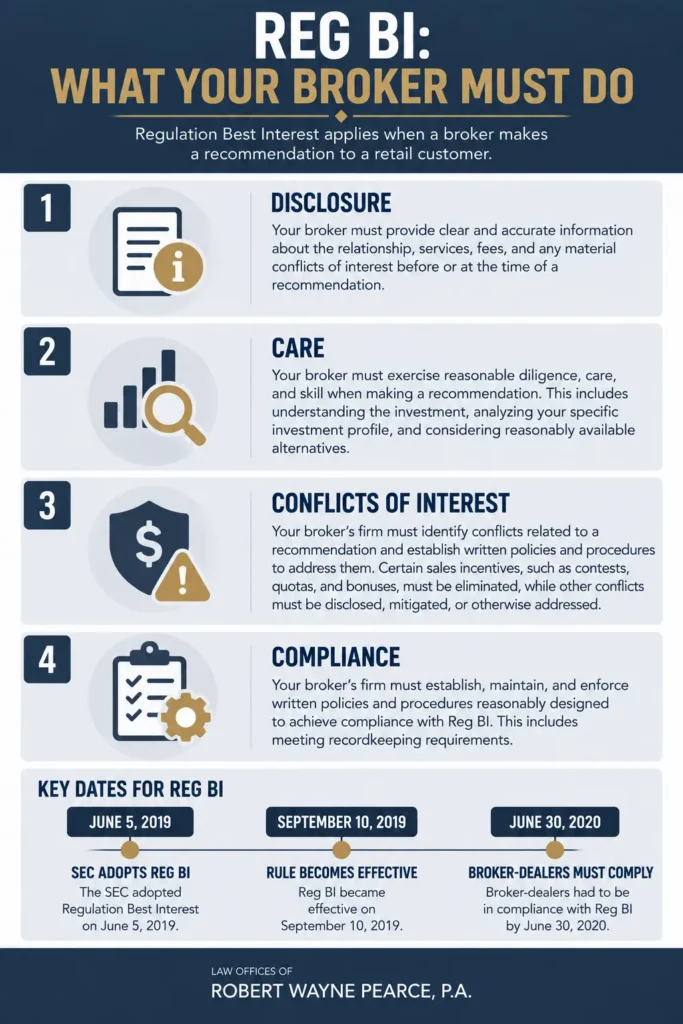
Next, in general terms, the “Best Interest” rule imposes four obligations upon broker-dealers and their associated persons:
1. Disclosure: to provide disclosures about the type of relationships they will have with their customer before or at the time of any recommendations (which will probably be buried somewhere in their website or the fine print of the 80-100 page customer agreement and disclosure booklets only made available via the internet when the account is opened).
2. Due Care: to exercise reasonable diligence, care, and skill in making the recommendation.
3. Conflicts: to establish, maintain, and enforce written policies and procedures reasonably designed to address conflicts of interest, preferably to avoid or mitigate them and, if they cannot be avoided, to make sure they are disclosed to the retail customer in a way the customer will understand the conflict and appreciate its impact on the recommendation.
4. Compliance: to establish, maintain, and enforce written policies and procedures reasonably designed to achieve compliance with Reg. BI.
It goes without saying that the new SEC rule also requires broker-dealers to comply with new recordkeeping requirements to be sure Reg. BI is being implemented and enforced.
When Reg BI Took Effect, and Why the Date Decides Your Claim
The SEC adopted Reg BI on June 5, 2019; the rule became effective on September 10, 2019; and broker-dealers had to be in compliance by June 30, 2020. Those are three separate dates, and the last two get mixed up constantly.
The compliance date is the one that decides which standard governs your claim. A recommendation your stockbroker made on June 29, 2020, is measured against FINRA’s old suitability rule. The same recommendation made two days later is measured against Reg BI, which asks harder questions about cost, alternatives, and conflicts.
FINRA moved on the same day. The Commission approved FINRA’s amendments to Rule 2111 in June 2020 and set their effective date as the compliance date of Reg BI. From that day forward, the suitability rule stopped applying to any recommendation that Reg BI covers.
How We Got Here: Ten Years From Dodd-Frank to Reg BI
Finally, ten years after the Dodd-Frank Wall Street Reform and Consumer Protection Act of 2010 (Dodd-Frank) was enacted to bring about sweeping changes to the securities industry, the best regulation the U.S. Securities & Exchange Commission (“SEC”) could pass, SEC Regulation Best Interest, is now the law governing broker-dealers giving investment advice to retail customers.
FINRA amended its Suitability Rule that same year. Now it steps aside whenever a recommendation is already covered by SEC Reg. BI. Reg BI puts real duties on stockbrokers around disclosure, care, conflicts, and compliance whenever they recommend something to a retail customer. Those duties ask more of a broker than the old suitability standard did. But they still stop short of the continuous fiduciary duty owed by an investment adviser. See FINRA Regulatory Notice 20-18.
Reg BI vs. Fiduciary Duty: Where the Two Standards Part Company
Reg BI and a fiduciary duty part company on three points: who each one binds, how long each one lasts, and what each one requires a firm to do about a conflict. Reg BI binds broker-dealers and their registered representatives, while a fiduciary duty binds registered investment advisers and comes from a different statute entirely.
The biggest difference for investors may be what happens after the recommendation. The SEC confirmed in the adopting release that Reg BI does not extend beyond a particular recommendation and does not impose a duty to monitor your account. An adviser’s fiduciary duty runs continuously, and monitoring is part of the duty of care. For an investor who bought once and then held for years while the position bled, that is the whole case.
Reg BI is, in some respects, stricter when it comes to these issues. Under the Conflict of Interest Obligation, a broker-dealer must identify conflicts tied to a recommendation and establish policies and procedures to disclose, eliminate, or mitigate them, depending on the circumstances.
Conflicts that create incentives for an individual representative to put their own interests ahead of the customer’s must be mitigated, while sales contests, sales quotas, bonuses, and non-cash compensation based on selling specific securities within a limited period must be eliminated.
The SEC was explicit that the standard of conduct established by Reg BI cannot be satisfied through disclosure alone. That is a real protection for you, and it is the one place where a stockbroker may owe you more than an investment adviser does.
Understanding Form CRS
Form CRS is the short relationship summary that broker-dealers and investment advisers must deliver to retail investors. The SEC adopted it alongside Reg BI on June 5, 2019, through Exchange Act Rule 17a-14 and Form CRS at 17 C.F.R. section 249.640.
The document has to give you succinct information about the relationships and services the firm offers, the fees and costs you will pay, specified conflicts of interest and standards of conduct, and the firm’s disciplinary history. The SEC built it for comparison shopping, so the same categories appear in the same order at every firm. That is the point of it. You are supposed to be able to hold two of them side by side and see which relationship you are actually being offered.
The relationship summary is not a substitute for the rest of the disclosure your firm owes you. The Commission said that in most instances the relationship summary alone will not satisfy the Disclosure Obligation, and that for a dual registrant it is not enough even to establish which capacity the professional is acting in. If you cannot find one in your account paperwork, that absence is worth raising with a lawyer.
Reg BI Is Better Than Rule 2111, and Still Not the Best
If anything is clear, Reg. BI may not be the best rule for investors, but it’s certainly better than old Rule 2111.
In the meantime, if you have any questions about the new “best interest” rule and whether your broker-dealer and/or its stockbroker have complied with their obligations, please contact us; the call is free!
CONTACT US FOR A FREE INITIAL CONSULTATION WITH EXPERIENCED FINRA ARBITRATION ATTORNEYS
The Law Offices of Robert Wayne Pearce, P.A. have highly experienced lawyers who have successfully handled many managed account cases and other securities law matters and investment disputes in FINRA arbitration proceedings, and they will work tirelessly to secure the best possible result for you and your case.
Attorney Pearce and his staff represent investors across the United States on a CONTINGENCY FEE basis, which means you pay nothing (NO FEES, NO COSTS) unless we put money in your pocket after receiving a settlement or FINRA arbitration award.
For dedicated representation by an attorney with over 45 years of experience and success in structured product cases and all kinds of securities law and investment disputes, contact the firm by phone at 833-300-6983, toll-free at 866-860-8961, or via e-mail.