
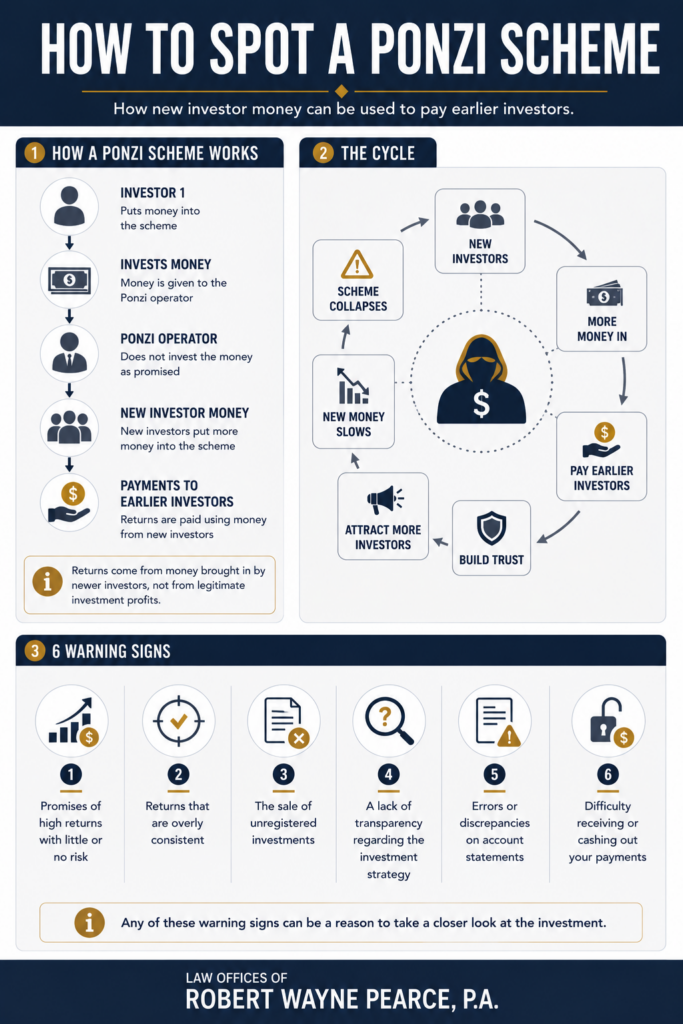
Ponzi-like schemes swindle investors out of millions of dollars every year. A common form of investment fraud, a Ponzi scheme occurs when existing investors receive distributions from funds provided by new investors rather than from legitimate investment profits.
Ponzi schemes only work if there are new investors putting money in. But once that stops, the scheme can collapse, and both new and existing investors can lose money.
While Ponzi schemes are illegal, they continue to exist. In fact, some sources have noted that in 2019 Ponzi schemes hit their highest levels in a decade.
If you are a victim of a Ponzi scheme, you may be wondering what recourse you have. Fortunately, there are actions you can take. Reporting a Ponzi scheme can help hold these fraudsters accountable and prevent other victims from being taken advantage of as well.
In this guide, our investment fraud lawyers will explain how to report a Ponzi scheme and what steps you can take if you have lost money to one.
What Is a Ponzi Scheme?
Financial advisors recommend investment strategies to investors based on their investment profile. In many situations, investors seek investments likely to result in returns based on the profitability of the investment.
Ponzi schemes eventually run out of new investors willing to put more money into the scheme. Once there’s not enough new money coming in, the operator can no longer keep up with payments to earlier investors and the scheme falls apart.
Anyone can fall victim to a Ponzi or Ponzi-like scheme. What’s important is that you know where to turn and what steps you can take moving forward.
With over 45 years representing investors, attorney Robert Pearce has the knowledge and experience you need to help you fight for your rights and recovery.
Examples of SEC Enforcement Actions Against Ponzi Schemes
In April 2021, the SEC charged Los Angeles-based actor Zachary Horwitz and his company, 1inMM Capital, LLC, in connection with a Ponzi scheme that reportedly raised over $690 million from investors.
Horwitz and his company represented to investors that the investment funds would be used to purchase film rights and that the films would then be sold to Netflix or HBO.
Horwitz allegedly claimed to have an extensive track record of selling movie rights to Netflix and HBO, despite the fact that he never maintained a business relationship with either company.
1inMM and Horwitz reportedly promised investors returns in excess of 35%. Instead, Horwitz paid early investors with the funds provided by new investors and misappropriated millions of dollars for himself.
In January 2020, the SEC charged California-based husband and wife Jeffrey and Paulette Carpoff with orchestrating a nearly billion-dollar Ponzi scheme involving alternative energy tax credits.
The pair reportedly raised approximately $910 million from 17 investors between 2011 and 2018 by offering securities in the form of investment contracts through two solar generator companies, DC Solar Solutions, Inc., and DC Solar Distribution, Inc.
The SEC alleged that the couple used at least $140 million of the investors’ funds to fund their lifestyle and used the remaining funds to issue dividends to earlier investors.
You may reach out to our investment loss attorneys today for additional support and to learn more about your options for pursuing recovery.
Indicators of a Ponzi Scheme
Many red flags associated with Ponzi schemes present themselves prior to and during the investment process.
Recognition of these characteristics before making your investment can prevent you from suffering serious losses down the road. Common indicators of a Ponzi scheme include:
- Promises of high returns with little or no risk;
- Returns that are overly consistent;
- The sale of unregistered investments;
- A lack of transparency regarding the investment strategy;
- Errors or discrepancies on account statements; and
- Difficulty receiving or cashing out your payments.
Investors should be skeptical and be aware if any of these warning signs are present before trusting an investment. Legal advice from an experienced securities lawyer can help you understand what happened and what options may be available to you.
Reporting a Ponzi Scheme
Ponzi schemes can cost investors millions of dollars in losses. The SEC and FBI provide resources for individuals who suspect financial fraud, investment scams, or other fraudulent activity to report the misconduct.
Federal Bureau of Investigation (FBI)
The FBI provides an electronic tip form to individuals wishing to report fraud and other federal law violations. Additionally, for internet-based crimes, the FBI offers another way to submit a tip. Because many Ponzi schemes begin and operate online, it may be the appropriate organization to contact when reporting an online Ponzi scheme.
Securities and Exchange Commission (SEC)
The SEC also provides defrauded investors an avenue to report suspected Ponzi schemes and other fraudulent activities. SEC Ponzi scheme tips can be submitted online directly through the SEC website.
What Information Should You Include When Reporting a Ponzi Scheme, and What Happens Next?
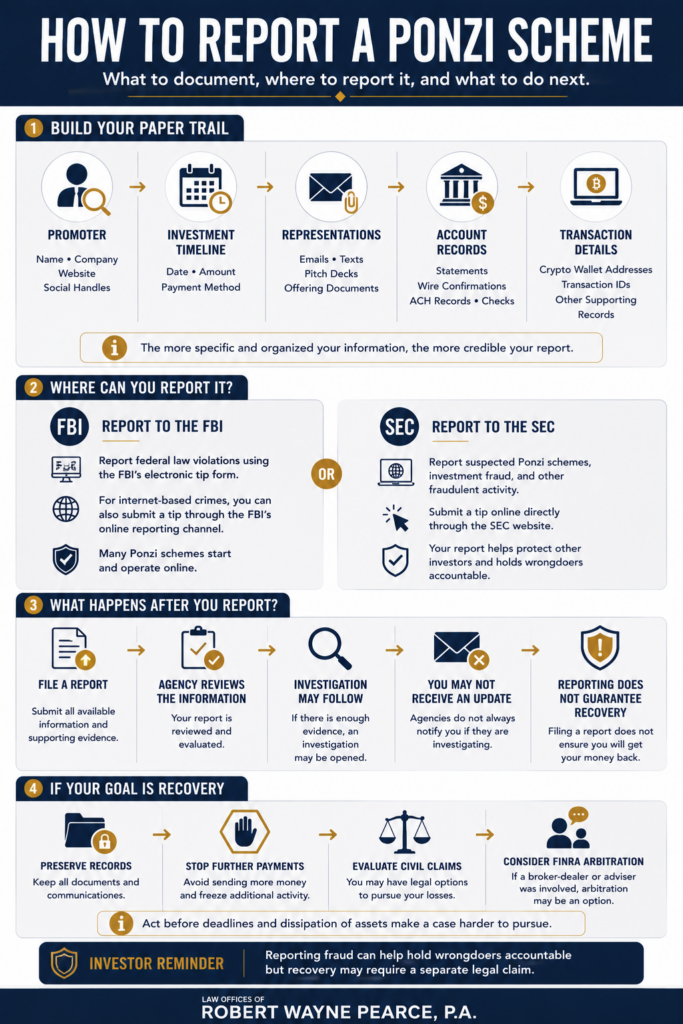
The information you should include when reporting a Ponzi scheme is a clear paper trail of who took the money, how it moved, and what was promised, because regulators triage cases based on specificity and corroboration.
At the Law Offices of Robert Wayne Pearce, P.A., we’ve seen that details equal credibility when an agency decides whether your complaint becomes an investigation.
A strong report contains the promoter’s identity (names, entities, websites, social handles), your investment timeline (date → amount → method), and proof of representations (emails, texts, pitch decks, offering documents, account statements).
Some reporting channels allow you to remain anonymous. Even so, providing your contact information may allow investigators to follow up if they need more information.
On top of that, you may also include critical supporting evidence like bank wire confirmations, ACH records, checks, crypto wallet addresses, transaction IDs, and any “guaranteed return” language related to a specific product or strategy.
After you file a report, you may not hear back from the SEC or FBI about whether they are investigating the matter. The agencies may not respond directly to every report, and filing it also doesn’t guarantee that you will recover your money. But the information you provide can assist investigators with their review.
If your intent is recovery, your next steps may include preserving records, stopping further payments, and evaluating civil claims (including FINRA arbitration when a broker-dealer or adviser is involved) before deadlines and dissipation of assets make the case harder.
Contact an Investment Loss Attorney Today
Investing your valuable and hard-earned money in an investment fraud is never easy. If this has happened to you, we want to help.
At the Law Offices of Robert Wayne Pearce, P.A., we have decades of experience helping investment loss victims in need.
Firm founder and lead attorney Robert Pearce has recovered funds for over 99% of his investor clients and recovered over $100 million in the last 20 years alone through court litigation, arbitration, and settlements.
Want to know more about how to report a Ponzi scheme? Give our team a call today to discuss your case and see what we can do for you.