



What does a Georgia investment fraud lawyer do?
A Georgia investment fraud lawyer represents investors who lost money because of broker misconduct. Broker misconduct means your stockbroker or financial advisor misstated an investment, recommended one that wasn’t in your best interest or traded without your permission. The lawyer files the claim to recover those losses.
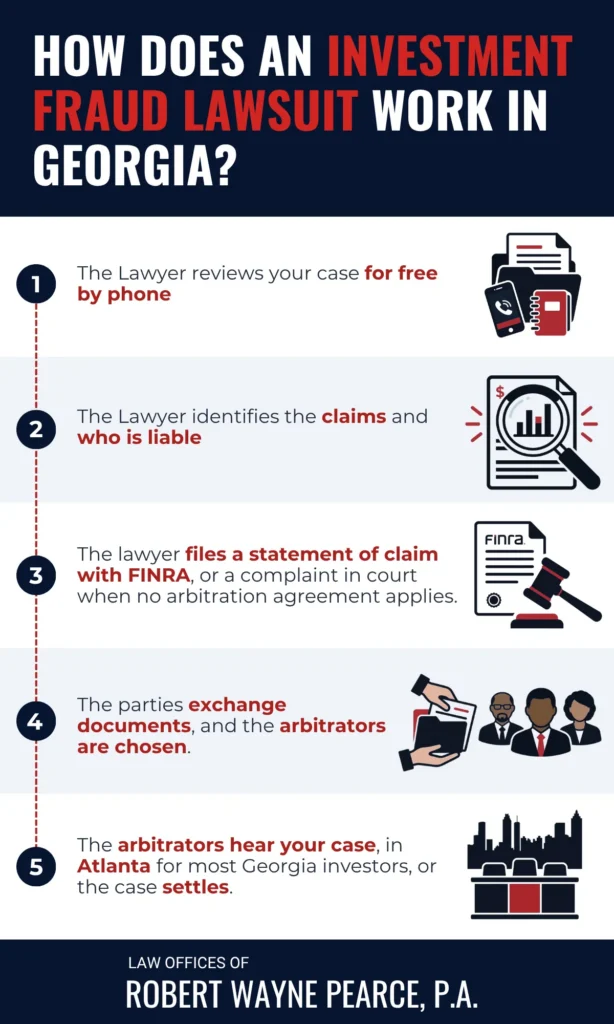
A Georgia investment fraud attorney does 5 things in your claim.
- Reviews your account statements, agreements and messages with the advisor.
- Identifies the misconduct and everyone who can be held liable, including the brokerage firm.
- Chooses the forum, usually FINRA arbitration.
- Files the claim before the deadline.
- Presents your case at the hearing or negotiates a settlement.
The forum is where your claim gets filed. FINRA arbitration means arbitrators, not a jury, decide a claim against a brokerage firm.
But a market loss alone is not a claim. Your loss has to come from misconduct, and whether it did is the real question. That’s what I look at first.
I was admitted in New York in 1980 and in Florida in 1982. I worked at the United States Securities and Exchange Commission (SEC) from 1980 to 1983.
How much does a Georgia investment fraud lawyer cost?
The consultation is free, and we work on a contingency fee. A contingency fee means you don’t owe an attorney fee unless we recover money.
So we match what happened to you against Georgia’s securities laws, because your claim rests on those laws.
Which Georgia laws does a securities fraud lawyer use?
The main law a Georgia securities fraud lawyer uses is the Georgia Uniform Securities Act of 2008, which starts at O.C.G.A. § 10-5-1. The part that lets you sue is its civil liability section, O.C.G.A. § 10-5-58.
The table below lists the 4 laws a Georgia securities attorney cites, what each does and its citation.
| Law | What it does | Citation |
|---|---|---|
| Georgia Uniform Securities Act of 2008 | Makes it unlawful to use a scheme to defraud, or to make an untrue statement or omit a material fact, in the offer, sale or purchase of a security. | O.C.G.A. § 10-5-50 |
| Civil liability section | Lets the buyer sue the seller and those who control or materially aid the seller. | O.C.G.A. § 10-5-58 |
| Georgia investment adviser rule | Makes an investment adviser a fiduciary. | Rules and Regulations of the State of Georgia (Ga. Comp. R. & Regs.) 590-4-4-.19 |
| Federal and FINRA rules | Set a stockbroker’s best interest duty and a brokerage firm’s duty to supervise. | Regulation Best Interest, 17 Code of Federal Regulations (C.F.R.) § 240.15l-1, and FINRA Rule 3110 |
A material fact is one that matters to the decision to invest.
The Securities Division of the Georgia Secretary of State’s office, in Atlanta, enforces the Act. But O.C.G.A. § 10-5-50 doesn’t itself give you a right to sue. O.C.G.A. § 10-5-58 does.
The Act has required brokerage and advisory staff to report suspected financial exploitation to the Commissioner of Securities since July 1, 2023. It covers a client aged 65 or older and an incapacitated adult. The brokerage or advisory firm can hold a disbursement, which is a payment out of the account, for up to 15 business days. The hold can reach 25 business days at the Commissioner’s request (O.C.G.A. §§ 10-5-100 to 10-5-108).
Does a complaint to the Georgia Securities Division recover your losses?
No. The Division can investigate and bring enforcement actions, but a complaint isn’t a claim for your money.
The Division acts for the public, so we read your account agreement to see where your own claim goes.
Where does a Georgia securities litigation attorney file your case?
A Georgia securities litigation attorney files most claims against a brokerage firm in FINRA arbitration, not in a Georgia court. That’s because the brokerage account agreement you signed usually requires arbitration.
The table below shows where your claim gets filed for each of the 3 types of opposing party.
| Who the claim is against | Where it is filed |
|---|---|
| A brokerage firm or its stockbroker | FINRA arbitration. |
| A registered investment adviser | The forum named in the advisory contract, which can be private arbitration or court. |
| A person or company that is not a FINRA member | A Georgia superior court or a federal district court in Georgia. |
Now, the agreement you signed when you opened the account usually shows which row applies to you. Bring that agreement to the first call, because we read it before anything gets filed.
Where would your FINRA hearing be held?
FINRA lists 69 hearing venues in 2026, and Atlanta is its Georgia location. FINRA Rule 12213(a) generally puts your hearing at the venue closest to where you lived when the events happened. You can ask for a home state venue if the closest one is in another state, but FINRA decides, so I can’t promise a city.
The FINRA forum is national, and the Georgia hearing location is Atlanta. That’s why your lawyer’s office doesn’t have to be in Georgia, and our office isn’t.
How do you find an investment fraud lawyer near you in Georgia?
Look for a lawyer whose practice is investor claims against brokerage firms and who handles FINRA arbitration. The office address of a securities fraud lawyer near you matters less. The first review is by phone, and the Georgia hearing venue is Atlanta.
You need to interview your attorney. Run these 5 checks on any investment fraud lawyer near you in Georgia.
- Confirm that the practice is investor claims against brokerage firms.
- Ask about FINRA arbitration experience.
- Check where the lawyer is licensed and whether the firm has a Georgia office.
- Review the fee, including the free consultation, the contingency fee and who pays costs.
- Ask whether the firm takes a case of your size, including a high net worth account.
Now, my office is at 1499 W Palmetto Park Rd #400, Boca Raton, FL 33486. We have no Georgia office.
We serve investors with losses exceeding $100,000 across Georgia by phone, including Atlanta, Savannah, Augusta, Columbus, Macon and Athens. You can call us at (866) 860-9572.
No lawyer at my firm is admitted in Georgia, so the next question is whether we can represent you.
Can a lawyer who is not admitted in Georgia represent you?
Yes, in FINRA arbitration. FINRA Rule 12208(b) lets you be represented by an attorney in good standing who is admitted to the highest court of any state, unless state law prohibits it.
There are 2 conditions. First, Georgia’s own rule on lawyers from other states still applies.
Second, a case in a Georgia court needs a Georgia licensed lawyer or the court’s permission.
I’m admitted in Florida and New York. Adam Kara-Lopez is admitted in Florida.
Neither of us is admitted in Georgia. And we have no Georgia office. You can check any lawyer’s Georgia license in the State Bar of Georgia member directory before we start your Georgia investment fraud claim.
How does an investment fraud lawsuit work in Georgia?
A Georgia investment fraud lawsuit against a brokerage firm usually runs as a FINRA arbitration claim in 5 steps.
- The lawyer reviews your case for free by phone. Bring your account statements, the new account or advisory agreement, offering documents, emails and texts with the advisor, and notes of conversations.
- The lawyer identifies the claims and who is liable.
- The lawyer files a statement of claim with FINRA, or a complaint in court when no arbitration agreement applies.
- The parties exchange documents, and the arbitrators are chosen.
- The arbitrators hear your case, in Atlanta for most Georgia investors, or the case settles.
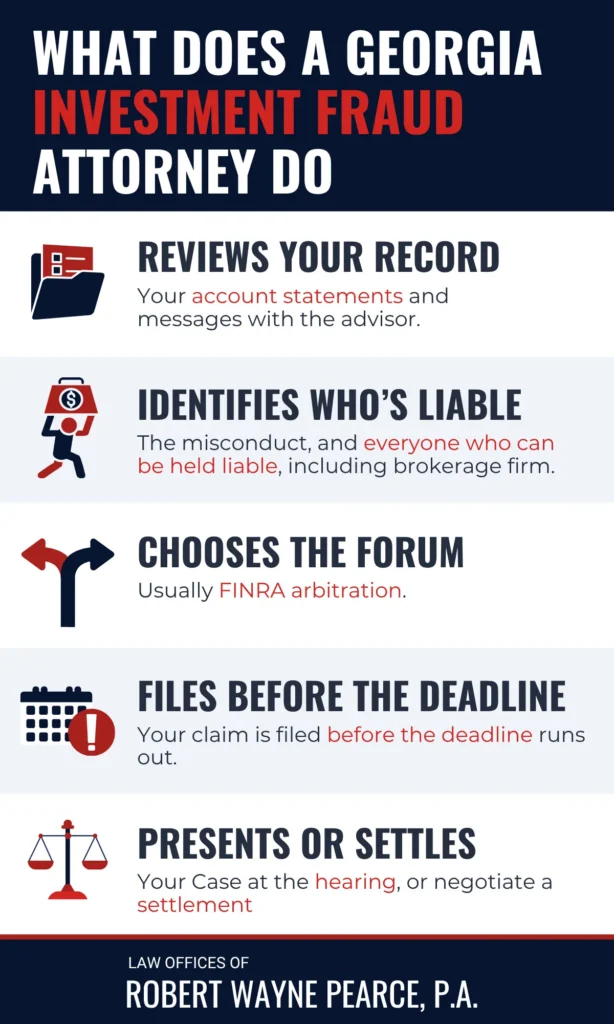
The third step decides whether your dispute is a FINRA arbitration claim or a Georgia securities fraud lawsuit in court. The statement of claim is the document that starts the arbitration, and it states the facts and the remedies you’re asking for.
That document sets the amount in dispute, so we tie the amount to the Georgia statute.
What can you recover in a Georgia investment fraud claim?
You can recover the price you paid, less income received. You can recover interest at the legal rate from the purchase date. You can recover costs and reasonable attorney fees. That’s the rule in O.C.G.A. § 10-5-58(b) if you bought a security because of an untrue statement or omission of a material fact.
The table below lists 4 situations under the Georgia Uniform Securities Act of 2008, what you can recover in each and its citation.
| Situation | What you can recover | Citation |
|---|---|---|
| You still own the security. | The price paid, less income received, plus interest from the date of purchase, costs and reasonable attorney fees, when you tender the security, which means you offer to exchange it for that amount. | O.C.G.A. § 10-5-58(b)(1) |
| You sold the security. | Actual damages, which are that amount less the value of the security when you disposed of it, plus interest, costs and attorney fees. | O.C.G.A. § 10-5-58(b)(3) |
| An adviser gave paid advice without the required registration. | The fee paid for the advice, interest from the date of payment, costs and attorney fees. | O.C.G.A. § 10-5-58(e) |
| A paid adviser used a scheme to defraud. | The fee paid, actual damages caused by the fraud, interest, costs and attorney fees, less income received. | O.C.G.A. § 10-5-58(f) |
Liability reaches people who control the seller, its managing partners, executive officers and directors, and employees, brokerage firms and advisers who materially aid the conduct. They’re jointly and severally liable unless they prove they didn’t know and couldn’t reasonably have known of the conduct (O.C.G.A. § 10-5-58(g)). So each one can owe you what the seller owes.
A contract term that waives these rights is void (O.C.G.A. § 10-5-58(l)).
But these rights expire. A late Georgia investment fraud claim can be dismissed whatever the loss, so we check your deadline before your damages.
How long do you have to file an investment fraud claim in Georgia?
You must file most misstatement or omission claims within the earlier of 2 years after discovery of the facts or 5 years after the violation. That’s the rule in O.C.G.A. § 10-5-58(j)(2).
The table below lists the 4 deadlines a Georgia investment fraud lawyer checks, with the claim and the citation for each.
| Claim | Deadline | Citation |
|---|---|---|
| Misstatement or omission in the sale of a security | The earlier of 2 years after discovery of the facts or 5 years after the violation. | O.C.G.A. § 10-5-58(j)(2) |
| Sale of an unregistered security, or a claim against an unregistered broker dealer, agent or adviser | 2 years after the violation. | O.C.G.A. § 10-5-58(j)(1) |
| Common law fraud | 4 years after the right of action accrues, and fraud that keeps the investor from suing can delay the start. | O.C.G.A. §§ 9-3-31 and 9-3-96 |
| Any claim in FINRA arbitration | Not eligible once 6 years have passed since the event, and this rule does not extend the Georgia deadlines. | FINRA Rule 12206(a) and (c) |
Unfortunately, the 5 year limit can end your claim before you discover the problem. A security sold to you in 2021 can pass that limit in 2026 before you learn of the misstatement.
When should you hire an investment fraud lawyer?
Hire a Georgia investment fraud lawyer as soon as you suspect misconduct. That’s because the shortest period is 2 years, and gathering your records takes time.
So we date the sale and the discovery first, and then we ask which duty your advisor owed you.
Is your financial advisor a fiduciary under Georgia law?
Yes, if the advisor acts as an investment adviser. Rule 590-4-4-.19 of the Georgia Commissioner of Securities makes an investment adviser, an investment adviser representative or a federal covered investment adviser a fiduciary. A fiduciary must act primarily for the benefit of its clients.
But that rule doesn’t automatically cover a stockbroker. A stockbroker must act in a retail customer’s best interest when recommending a security under SEC Regulation Best Interest.
Georgia law treats a relationship as confidential when one party can exercise a controlling influence over another’s interests (O.C.G.A. § 23-2-58).
Use FINRA BrokerCheck to see whether your advisor is registered as a stockbroker, an adviser or both. We check it before any Georgia breach of fiduciary duty claim.
Which investment fraud claims can a Georgia investor bring?
We handle the 6 claims below for Georgia investors. Each claim has its own page on our site, so you only need to read the one that matches your loss.
Investment fraud claims nationwide
We represent investors in Georgia and across the United States from our Boca Raton office. Our national page explains the types of investment fraud and the damages an investment fraud attorney can pursue.
Stockbroker fraud claims
Most Georgia investment fraud claims name a stockbroker and the brokerage firm that supervised the stockbroker. A stockbroker fraud lawyer can bring claims for churning, unauthorized trading and unsuitable recommendations, and those are claims we handle.
Suing a financial advisor over investment losses
An advisor who is a fiduciary can be liable for the losses caused by breaking that duty. Our guide explains when you can sue your financial advisor and what evidence you need.
Atlanta investment fraud claims
FINRA’s Georgia hearing location is Atlanta, and the Atlanta metro area is the largest in Georgia. You can read our page for an Atlanta investment fraud attorney if you live in Fulton, DeKalb, Cobb or Gwinnett County.
Stock market loss claims
A market drop alone isn’t a Georgia investment fraud claim, but a loss caused by your stockbroker’s misconduct can be one. We explain how an attorney can help you recover stock market losses.
FINRA arbitration claims
FINRA arbitrators, not a jury, decide most Georgia investment fraud claims against brokerage firms. That’s why you need a FINRA arbitration lawyer to prepare your statement of claim and present your case at the hearing, so call us and we’ll answer your questions.