
If you’re here, chances are you suspect a broker or brokerage firm cost you money through misconduct, and you want answers. Our investment fraud law firm is here to provide them and hold the responsible parties accountable.
FINRA stands for the Financial Industry Regulatory Authority. It’s a not-for-profit self-regulatory organization that oversees U.S. broker-dealers and their brokers under the supervision of the Securities and Exchange Commission. FINRA enforces financial services industry rules and operates the largest securities dispute resolution forum in the United States, where investors can pursue claims. If you’ve been defrauded, FINRA arbitration gives you a direct path to recover your losses without going to court.
An investment fraud lawyer can help by evaluating your claim, guiding you through the arbitration process, and representing you before the panel. In this guide, we’ve laid out how arbitration works step by step. We cover the key FINRA rules, expected timelines, and what to ask an attorney before hiring one.
What is FINRA Arbitration?

FINRA arbitration is a forum for resolving customer disputes between investors and their brokerage firms or brokers, outside of court. It involves presenting evidence and arguments to a panel of arbitrators, who make a binding decision, called an award, on the dispute.
As an investor, if you have suffered considerable investment losses caused by the behavior of your broker, then FINRA arbitration may be a viable solution. By filing for arbitration with FINRA, you could be entitled to recoupment or compensation from the brokerage firm responsible.
FINRA does not require you to hire a lawyer, but its guidance says you should consider it. Brokerage firms are generally represented by counsel, so a qualified FINRA arbitration lawyer levels the playing field before you file.
FINRA Overview

What Is FINRA?
FINRA is a self-regulatory organization for brokerage firms and the brokers who work for them. Its core functions cover oversight, enforcement, and dispute resolution. FINRA is a self-governing body and operates independently from the U.S. government, though it works under the supervision of the Securities and Exchange Commission.
By contrast, the SEC regulates the buying and selling of securities on U.S. exchanges such as the New York Stock Exchange, NASDAQ, and NYSE American. The SEC reviews and declares registration statements effective for initial public offerings and secondary offerings. The agency can also suspend trading in a security for up to ten business days when the investing public may be at risk.
The SEC’s authority doesn’t stop at regulation, either. It also carries law enforcement powers, and it often works alongside the FBI and the U.S. Attorney’s Office when investigating securities transactions. When those investigations uncover crimes relating to the stock market, such as insider trading or wire fraud, the U.S. Attorney can step in and pursue criminal charges.
Beyond these criminal referrals, the SEC has the authority to file civil lawsuits against any person or organization violating the securities statutes and the SEC’s rules.
How Is FINRA Different from the SEC?
FINRA has a different function than the SEC altogether. FINRA is a regulatory body designed to promote public confidence in the brokerage industry and the financial markets. People will not invest if they believe they have trusted unscrupulous financial advisors to protect their economic interests.
FINRA ensures that its members comply with the ethical rules of their profession, similar to a state bar for attorneys or a board of registration for medical professionals.
Federal law makes FINRA responsible for supervising its member firms. FINRA investigates complaints investors make concerning misconduct, fraud, or potentially criminal behavior. As a result, FINRA can discipline its members if the agency determines that a broker violated its professional code.
FINRA can assess fines, place restrictions on a broker’s authority, or expel the member from its ranks for an egregious violation. Anyone who suspects their broker or their financial advisor of wrongdoing should file a complaint with FINRA’s Investor Complaint Center.
You should be aware that FINRA’s rules do not restrict you from filing a complaint seeking an investigation into wrongdoing and pursuing monetary damages in arbitration.
Costs Associated with FINRA Arbitration
The parties engaged in a FINRA arbitration proceeding can dispute discovery requests. Seeking resolution of these requests costs the parties money. The total cost of the FINRA arbitration process depends on the work the parties request from the arbitrator.
The case will be less expensive for both parties if they work together to avoid unnecessary discovery disputes. Cases can also proceed faster because arbitrators do not hear motions for summary judgment. They decide the matter based on the facts and the applicable law in one hearing.
The person requesting FINRA arbitration must pay a filing fee. FINRA assesses this fee based on the size of the claim. Brokerage firms that are parties to a case also pay separate amounts, including a member surcharge and a process fee.
FINRA’s filing fees also change depending on whether the relief requested is a specific dollar amount, like a contract sum, or unspecified damages.
FINRA accepts fee waiver requests if the filing fee would cause a financial hardship. FINRA also refunds part of the filing fee if a case settles or is withdrawn more than 10 calendar days before a scheduled hearing.
If you believe that your broker’s or financial advisor’s acts or omissions caused you to lose money, contact a knowledgeable attorney. Experienced counsel can guide you through recovery.
What Types of Cases Do FINRA Arbitrators Hear?
Understanding what types of claims FINRA arbitrators commonly hear may help you determine whether you should submit your claim to arbitration.
According to FINRA’s dispute resolution statistics, the most common causes of action investors pursue before FINRA arbitrators include the following.
- Breach of fiduciary duty.
- Negligence.
- Failure to supervise.
- Misrepresentation.
- Breach of contract.
- Suitability.
- Omission of material facts.
- Fraud.
- Breach of Regulation Best Interest.
- Blue Sky law violations.
- Manipulation.
- Elder financial abuse.
FINRA arbitrators build specialized knowledge about the subject matter because they work with these principles of law all the time. A typical judge sitting in court may not have exposure to these problems. The judge might miss some of the nuances of the securities business that a FINRA arbitrator would catch.
Does FINRA Arbitration Apply Only to Stocks?
Not every case that FINRA arbitrators hear involves stock transactions. FINRA arbitrators hear a variety of legal challenges. Individual investors have filed claims concerning many types of securities.
- Purchasing and selling common stock.
- Private equity transactions.
- Real estate investment trusts (REITs).
- Buying and selling options.
- Mutual fund transactions.
- Exchange-traded funds (ETFs).
- Structured products.
- Limited partnership agreements.
- Corporate bonds and municipal bond funds.
- Annuities, including variable annuities.
- 401(k) portfolios.
An arbitration case could include more than one of these topics. FINRA arbitrators are well-versed in how these securities work. They understand market pricing, risk assessment, and related concepts.
How Long Does FINRA Arbitration Take?
FINRA arbitration can take anywhere from 12 to 18 months from your initial filing to a final decision. Several factors shape that timeline.
- Case complexity: Disputes involving multiple parties, large claims, or intricate facts require more time for scheduling and panel availability.
- Discovery and motions: Exchanging evidence and resolving pre-hearing motions can extend the timeline.
- Settlement or mediation: Reaching an agreement before a final hearing can conclude the matter far sooner.
Most cases that proceed to a full evidentiary hearing average around 16 months. Smaller claims of $50,000 or less handled through simplified procedures often resolve much faster. Cases that settle before reaching a final hearing also close sooner. Every claim carries its own set of variables, so your actual timeline may fall outside these ranges. The strength of your documentation, the responsiveness of the opposing party, and the availability of the arbitration panel all shape how quickly your case moves. An experienced attorney can help you anticipate delays and keep your case on the most efficient path possible.
How Does FINRA Arbitration Work?
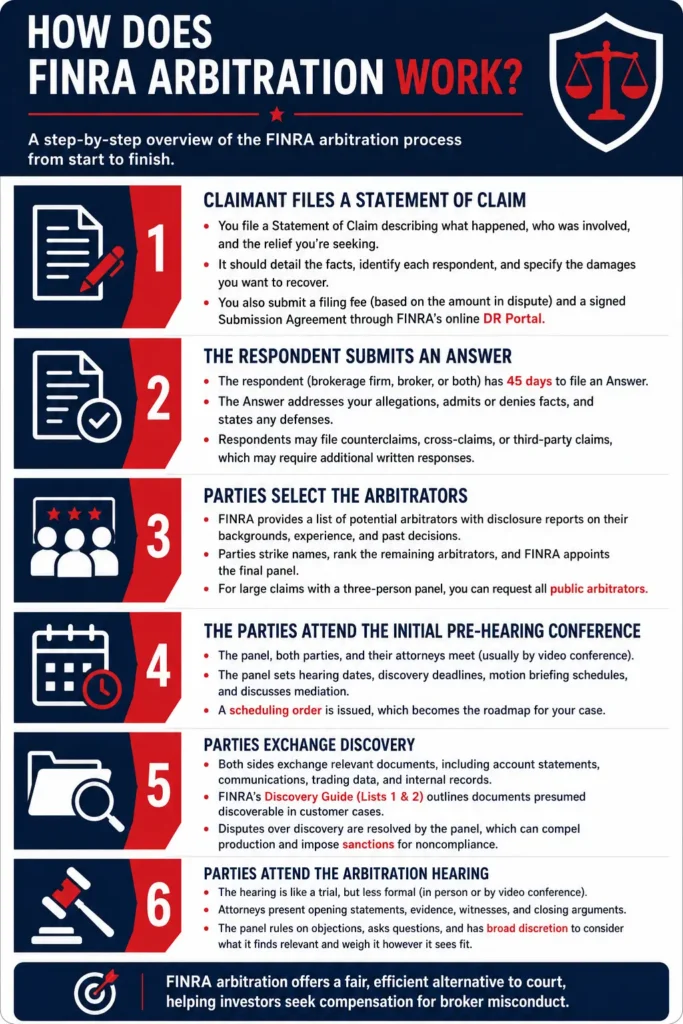
Now, our team will walk you through how FINRA arbitration works from start to finish based on our four decades of experience.
1. Claimant Files a Statement of Claim
The process begins when you, the claimant, file a Statement of Claim. This document is the foundation of your case. It lays out what happened, who was involved, and the relief you are seeking. A strong Statement of Claim describes the dispute, identifies each respondent, and details the facts supporting your allegations. It also specifies the damages you want to recover. The more precise and well-organized it is, the better positioned you are as the case moves forward. Along with the claim, you must submit a filing fee based on the amount in dispute and a signed Submission Agreement. Everything is filed with FINRA Dispute Resolution Services, typically through the online DR Portal. That opens your case and starts the timeline.
2. The Respondent Submits an Answer
Once your Statement of Claim is served, the other side gets a chance to respond. The respondent, whether a brokerage firm, an individual broker, or both, has 45 days to file an Answer. That deadline exists for a reason. It keeps your case moving and stops the other side from dragging things out.
The Answer itself tells you a lot. In it, the respondent must address your allegations one by one. They admit some facts, deny others, and lay out any defenses they plan to raise. Think of it as an early preview of their strategy. It shows you exactly how they intend to fight your claims.
Sometimes the respondent pushes back harder. They might file a counterclaim against you, a cross-claim against another respondent, or a third-party claim that pulls someone new into the dispute. Any of these filings widens the case, and each one may require its own written response before things can move forward.
3. Parties Select the Arbitrators
With the pleadings done, attention turns to the people who will decide your case. FINRA sends both sides a list of potential arbitrators along with disclosure reports on their backgrounds, experience, and past decisions. Your attorney’s judgment matters a lot in arbitrator selection, since the makeup of the panel can influence everything that follows.
There are two types of arbitrators to know about. Public arbitrators have no real ties to the securities industry. Non-public arbitrators do, often through prior work at firms. If your claim is large enough for a three-person panel, you can ask for all public arbitrators.
Each side then strikes a few names, ranks whoever remains, and FINRA merges those rankings to appoint your panel.
4. The Parties Attend the Initial Pre-Hearing Conference
Once the panel is in place, everyone gets on a call for the initial prehearing conference. It usually happens by video conference. That meeting might sound like a formality, but it sets the roadmap for your entire case. The arbitrators, both parties, and their attorneys all participate.
Expect the conversation to be practical. The panel works with both sides to set hearing dates, establish discovery deadlines, and schedule briefing on any motions. You’ll also cover housekeeping matters like whether mediation is worth exploring along the way.
Everything agreed upon gets written into a scheduling order. That order becomes the timeline governing the case from that point forward. Miss a deadline in that order and you risk real consequences, so it carries genuine weight.
5. Parties Exchange Discovery
The discovery process is the formal exchange of evidence, and it often determines the strength of your case. Both parties must produce documents relevant to the dispute. For investors, that typically includes account statements and correspondence with the broker. It also covers new account forms and records establishing losses. The firm must produce materials such as internal communications, compliance records, and trading data.
FINRA structures this process through its Discovery Guide, which contains two lists of documents presumed discoverable in every customer case. List 1 identifies what firms must produce. List 2 identifies what investors must provide.
When disputes arise, such as a party withholding documents or objecting to requests, the panel resolves the issue and can compel production. Failure to comply may result in sanctions.
6. Parties Attend the Arbitration Hearing
After months of preparation, everything comes down to the final hearing. Think of it as a trial with fewer formalities. Instead of a courtroom, you’re typically sitting in a conference room or joining by video conference. Instead of a judge and jury, your arbitration panel runs the proceeding. They rule on objections, keep things on track, and jump in with their own questions whenever something needs clarifying.
Your attorney opens by framing the case for the panel, then walks through your evidence piece by piece. Witnesses take the stand under oath, face cross-examination, and put documents into the record to support the narrative. The other side does the same. Once everything is on the table, both attorneys close with their strongest arguments for why the panel should see things their way.
One key difference: arbitration doesn’t follow the strict evidentiary rules you’d see in court. The panel has broad discretion to consider whatever it finds relevant and weigh it however it sees fit.
7. Arbitrators Deliberate and Render the Award
Once the hearing wraps up, the panel goes behind closed doors to deliberate. They review the testimony, weigh the evidence, and work toward a fair resolution. Under FINRA’s rules, the panel issues its award within 30 business days after the record closes.
The award itself is typically straightforward. It states who won, how much is owed, and whether any specific claims were denied. Don’t expect a detailed explanation of the panel’s reasoning. That’s just how FINRA arbitration works, unless both sides jointly request an explained decision before the hearing begins.
From there, the arbitration process moves fast. The losing party has 30 days to pay, and the panel’s decision is essentially final. Courts will step in only under extreme circumstances like fraud, corruption, or clear arbitrator misconduct. Simply disagreeing with the outcome isn’t enough to get it overturned.
How to File FINRA Arbitration
Initiating arbitration begins with filing a document called a “statement of claim” with FINRA. FINRA calls the party who filed first the claimant. The party answering the claim is the respondent.
The statement of claim is similar to a complaint filed in civil court. The statement of claim should give enough information to notify the respondent and the arbitrator about the case.
- The identity of all relevant parties.
- The nature of the dispute.
- All relevant dates.
- A demand for relief.
A claimant’s demand for relief is the remedy the claimant seeks by filing an arbitration claim. The demand should specify the type of relief desired. That may include monetary damages, interest, and contract damages (liquidated damages). It should also cover specific performance of the contract, if applicable.
FINRA requires parties to file claims through its online DR Portal. Investors who represent themselves can choose to file by mail instead.
FINRA will accept a case for arbitration if the claimant files a submission agreement and pays the required fee. FINRA will also review the statement of claim to determine if the claimant met all of the requirements. If not, FINRA will notify the claimant and give the claimant a chance to rectify the problem.
FINRA will officially serve the respondent with a claim notification letter. That letter gives the respondent access to the statement of claim, the supporting documents, and a blank submission agreement to sign and return.
Related Reads: How to File a Formal Complaint Against Your Financial Advisor
What Should I Ask a FINRA Attorney?
Before you hire anyone, make sure your initial conversation covers the right ground. Here are the key questions worth asking.
- Experience and track record: How many FINRA cases have they handled, and what results have they gotten on claims like yours? The answer tells you fast whether they actually know this process.
- Case strategy: Have them walk you through the strengths and weaknesses of your situation. A good attorney won’t sugarcoat it, and their recommended approach should make sense to you before you move forward.
- Fees and costs: Most FINRA attorneys work on contingency, but don’t assume that covers everything. Clarify whether you’d owe anything out of pocket for hearing fees or expert witnesses if the case doesn’t pan out.
- Timeline: Ask how long it typically takes to get from filing to a final hearing and award, so you’re not left guessing about the months ahead.
- Representation: Find out who will actually manage your file day to day. The person sitting across from you in a consultation isn’t always the one doing the work.
FINRA vs. Other Forms of Dispute Settlement
If you’re weighing your options, it helps to understand how FINRA arbitration stacks up against other ways to resolve securities-related disputes.
FINRA vs. Mediation
Mediation and FINRA arbitration get lumped together a lot, but they work very differently. In mediation, a neutral third party helps both sides negotiate toward a voluntary agreement. Nobody forces a decision on you. If talks break down, you walk away and explore other options. FINRA arbitration is binding. Once a panel issues an award, that’s your outcome, and the grounds for appealing it are razor thin. Mediation tends to be faster and cheaper, which makes it appealing when both parties are at least somewhat willing to compromise. If the other side isn’t negotiating in good faith, mediation won’t get you anywhere. You’ll end up in arbitration anyway.
FINRA vs. Litigation
Litigation means taking your case to court. You get a judge and a jury, formal rules of evidence, and a process that can stretch on for years. FINRA arbitration skips most of that. There’s no jury, only limited discovery, and looser evidentiary rules. That streamlined arbitration process is the whole point. Cases move faster, costs stay lower, and you’re in front of a panel that actually understands the securities industry. The tradeoff? You give up certain rights. There’s almost no appeals process, and you won’t get the kind of detailed written opinion a court would issue. For most investor disputes, though, arbitration is the required path because your brokerage agreement almost certainly includes a mandatory arbitration agreement.
FINRA vs. AAA Arbitration
Both FINRA and the American Arbitration Association handle disputes through arbitration, but that’s roughly where the similarities end. FINRA is purpose-built for the securities industry. Its arbitrators carry backgrounds in finance, brokerage, and securities law. AAA covers a much wider range of commercial disputes, from construction to employment to business contracts. Its arbitrators reflect that broader scope. The procedural rules differ too. FINRA operates under the FINRA Code of Arbitration Procedure and maintains a specific Discovery Guide tailored to investor-broker disputes. AAA uses its own commercial rules. If your case involves a broker or brokerage firm, FINRA is almost always the forum you’ll end up in, because that’s what the industry’s arbitration agreements require.
What is the FINRA Arbitration Statute of Limitations?
FINRA arbitration’s eligibility deadline for submitting an arbitration claim is six years from the date of the event or occurrence giving rise to the claim.
If you miss that window, the panel can dismiss your case outright, regardless of how strong your evidence is. This rule lives in FINRA Rule 12206, which treats the six-year window as a claim eligibility limit rather than a traditional statute of limitations. The practical effect is the same.
This isn’t the same as a state statute of limitations, which may be shorter or longer depending on the circumstances of your claim and where you live. Both timelines can apply, and the one that expires first controls. Even if your state gives you more time, FINRA’s six-year rule can still shut the door.
The bottom line: don’t wait. The longer you sit on a potential claim, the more you risk losing your right to pursue it.
FINRA Rules: What Are the Most Important FINRA Rules?
FINRA’s rules exist to enforce high standards of commercial honor, fair dealing, and accountability across the securities industry. Here are the most important ones to know.
Rule 2010 (Standards of Commercial Honor and Principles of Trade)
FINRA Rule 2010 requires FINRA member firms and their associated persons to observe high standards of commercial honor and just and equitable principles of trade. The rule is broadly applied to catch deceptive practices and misrepresentation. It also covers unauthorized trading and outright theft.
Rule 2020 (Use of Manipulative, Deceptive, or Other Fraudulent Devices)
FINRA’s primary anti-fraud rule. It prohibits FINRA member firms from using manipulative, deceptive, or other fraudulent devices. That prohibition covers effecting transactions or inducing the purchase or sale of any security.
Rule 2111 (Suitability)
FINRA Rule 2111 requires brokers to have a reasonable basis for believing that any recommended transaction fits the customer’s investment profile. That profile includes risk tolerance, investment objectives, and financial situation. Violations like churning, where a broker makes excessive trades to generate commissions, frequently fall under this rule.
Rule 4512 (Customer Account Information)
Rule 4512 requires firms to maintain accurate and current records for every customer account. Those records must include the customer’s name and residence. They must also note whether the customer is of legal age and other required account information. This matters because those records form the baseline for determining whether recommendations were suitable. If a firm lets account information go stale or records it inaccurately, it becomes much harder to argue they were acting in the customer’s best interest.
Rule 3110 (Supervision)
Rule 3110 places the burden on brokerage firms to establish and maintain a system, including written procedures, that reasonably supervises the activities of their associated persons. If a broker commits fraud and the firm fails to supervise properly, the firm can be held liable.
Rule 3310 (Anti-Money Laundering Compliance Program)
This rule requires FINRA member firms to develop and implement a written AML program approved by senior management. The program must be reasonably designed to comply with the Bank Secrecy Act. It must also detect and report suspicious activity tied to money laundering, fraud, and market manipulation.
Choose an Investment Fraud Attorney Who Knows FINRA Inside and Out
If you’ve lost money due to broker misconduct, you don’t have to face the FINRA arbitration process alone. An experienced stockbroker fraud lawyer can evaluate your claim, build your case, and fight for the recovery you deserve in front of the panel. That includes losses tied to a Ponzi scheme or other fraudulent conduct. The sooner you act, the stronger your position. Contact us today for a free consultation to discuss your situation and find out what options are available to you.ith the Law Offices of Robert Wayne Pearce.